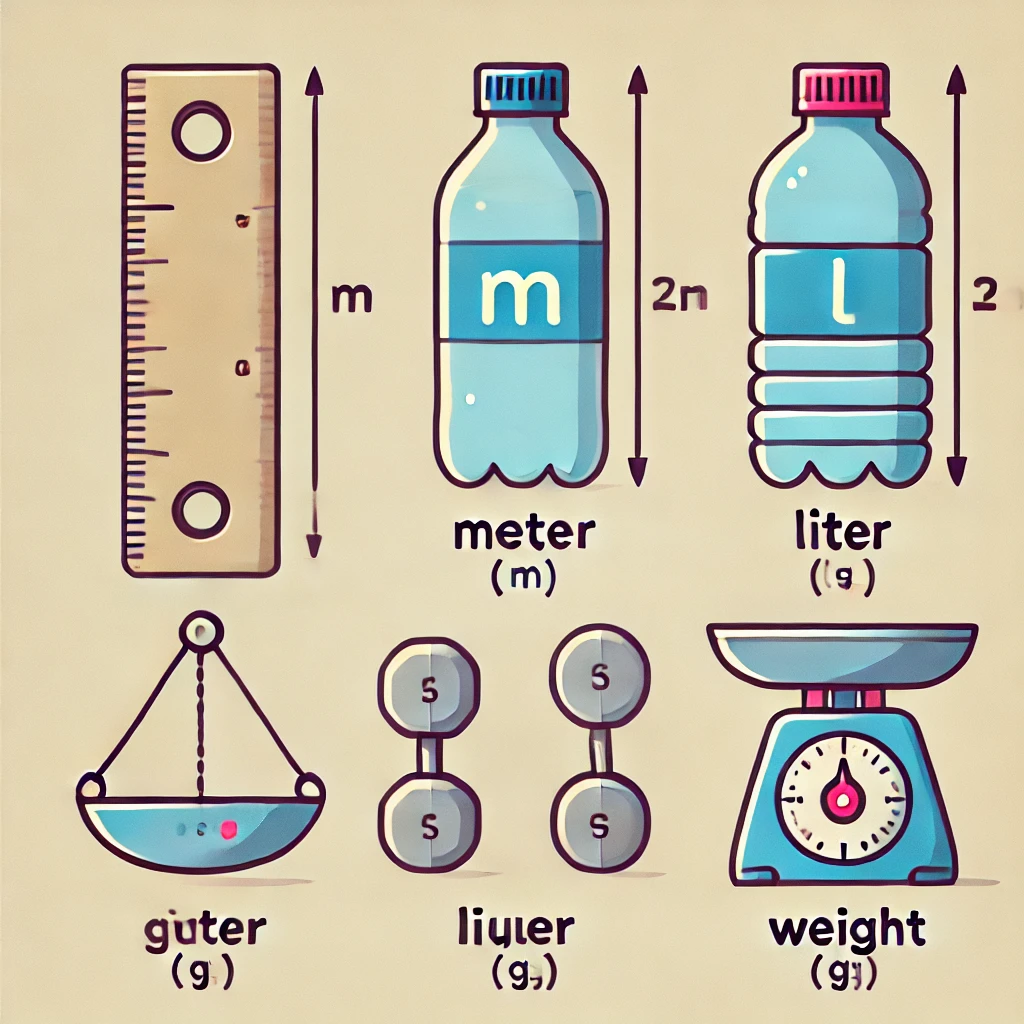
In the Metric System (SI), what is the basic unit of measurement & abbreviation for the following:
Distance (length):
Liquid Volume:
Mass (weight):
The correct answer and explanation is :
Basic Units of Measurement in the Metric System (SI):
- Distance (Length) – Meter (m)
- Liquid Volume – Liter (L)
- Mass (Weight) – Gram (g)
Explanation:
The metric system, also known as the International System of Units (SI), is a decimal-based system of measurement used worldwide in science, industry, and everyday life. It provides standardized units that make measurements simple and consistent.
- Meter (m) – Unit of Length
The meter is the fundamental unit of length in the metric system. It was originally defined in 1799 as one ten-millionth of the distance from the equator to the North Pole. Today, it is precisely defined by the distance light travels in a vacuum in 1/299,792,458 of a second. The metric system allows for easy conversions using prefixes like kilometer (km), centimeter (cm), and millimeter (mm). - Liter (L) – Unit of Liquid Volume
The liter is the primary unit for measuring liquid volume. One liter is equal to 1,000 cubic centimeters (cm³) or 1 cubic decimeter (dm³). It is commonly used for measuring water, beverages, and other fluids. The metric system also includes milliliters (mL), where 1,000 mL = 1 L. - Gram (g) – Unit of Mass
The gram is the standard unit of mass. It is based on the kilogram (kg), which is the SI base unit of mass. 1 kilogram (kg) = 1,000 grams (g). The gram is commonly used in everyday life to measure food, ingredients, and small objects.
This system simplifies calculations by using a base-10 structure, making it easier to understand and use worldwide.