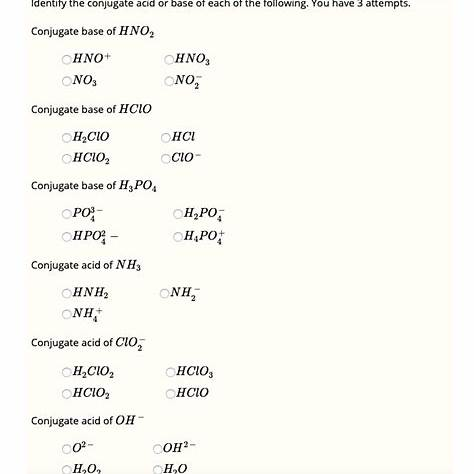
The conjugate base of HClO3 is
A) HClO2.
B) ClO3-.
C) Cl(OH)2.
D) ClO3.
E) HClO.
The correct answer and explanation is :
The correct answer is:
B) ClO₃⁻ (Chlorate ion).
Explanation:
To determine the conjugate base of HClO₃ (chloric acid), we need to recall the Brønsted-Lowry acid-base theory, which states that an acid donates a proton (H⁺) and its conjugate base is what remains after the proton is removed.
Step 1: Identify the Acid and Remove a Proton
The given acid is HClO₃. When it donates a proton (H⁺), we are left with:
[
HClO₃ \rightarrow H⁺ + ClO₃⁻
]
Thus, the conjugate base of HClO₃ is ClO₃⁻ (chlorate ion).
Step 2: Eliminate Incorrect Choices
- (A) HClO₂ – This is chlorous acid, not the conjugate base of chloric acid.
- (C) Cl(OH)₂ – This is not a commonly known species in acid-base chemistry.
- (D) ClO₃ – This represents the chlorate radical but lacks charge, whereas the correct conjugate base is ClO₃⁻.
- (E) HClO – This is hypochlorous acid, not the conjugate base of chloric acid.
Thus, the correct answer is B) ClO₃⁻.
Concept Recap:
- A conjugate base is formed when an acid loses a proton (H⁺).
- The acid-base pair HClO₃ / ClO₃⁻ follows this principle.
- ClO₃⁻ is the remaining ion after H⁺ is removed from chloric acid.