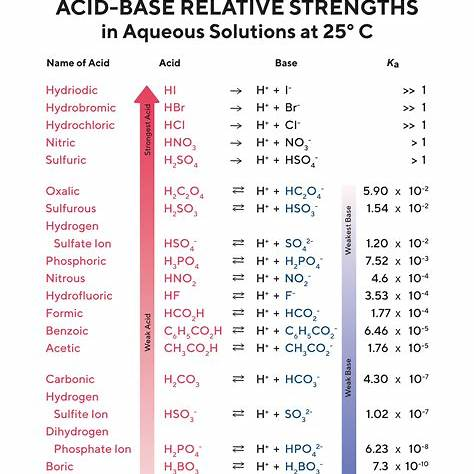
Which of the following is the weakest acid?
A) HF (Ka for HF is 7.2 × 10⁻⁴)
B) HCN (Ka for HCN is 4.9 × 10⁻¹⁰)
C) HCNO (Ka for HCNO is 2 × 10⁻⁴)
D) H3BO3 (Ka for H3BO3 is 5.4 × 10⁻¹⁰)
The correct answer and explanation is :
The weakest acid among the given choices is H3BO3 (boric acid) because it has the smallest acid dissociation constant (Ka = 5.4 × 10⁻¹⁰).
Explanation:
The strength of an acid is determined by its Ka value—the higher the Ka, the stronger the acid, since it indicates a greater extent of ionization in solution. Conversely, a smaller Ka value means the acid ionizes less in water, making it a weaker acid.
Let’s compare the Ka values of the given acids:
- HF (Hydrofluoric acid) → Ka = 7.2 × 10⁻⁴
- This is a moderately weak acid but still significantly stronger than the others.
- HCN (Hydrocyanic acid) → Ka = 4.9 × 10⁻¹⁰
- A very weak acid, meaning it ionizes very little in solution.
- HCNO (Cyanic acid) → Ka = 2 × 10⁻⁴
- Stronger than HCN but weaker than HF.
- H3BO3 (Boric acid) → Ka = 5.4 × 10⁻¹⁰
- The weakest acid among the given choices.
Why is H₃BO₃ the weakest?
Unlike the other acids that donate protons (H⁺) directly, boric acid does not act as a traditional Brønsted-Lowry acid. Instead, it behaves as a Lewis acid, reacting with water to form the complex ion [B(OH)₄]⁻ while releasing H⁺ indirectly:
[
H_3BO_3 + H_2O \rightleftharpoons [B(OH)_4]^- + H^+
]
Since this process is less efficient in releasing H⁺, boric acid has a very low Ka, making it the weakest acid in this list.
Correct Answer:
D) H₃BO₃ (boric acid)