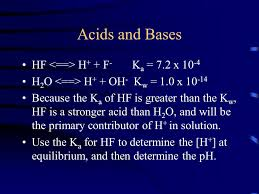
Which of the following is the weakest acid?
A) HF (Ka for HF is 7.2 × 10⁻⁴)
B) HCN (Ka for HCN is 4.9 × 10⁻¹⁰)
C) HCNO (Ka for HCNO is 2 × 10⁻⁴)
D) H3BO3 (Ka for H3BO3 is 5.4 × 10⁻¹⁰)
The correct answer and explanation is :
The strength of an acid is determined by its acid dissociation constant (Ka); the larger the Ka value, the stronger the acid, as it dissociates more readily in solution. Conversely, a smaller Ka value indicates a weaker acid.
Let’s analyze the given acids and their Ka values:
- A) HF (Ka = 7.2 × 10⁻⁴): Hydrofluoric acid has a moderate Ka value, indicating it is a weak acid but not the weakest among the options.
- B) HCN (Ka = 4.9 × 10⁻¹⁰): Hydrocyanic acid has a significantly smaller Ka value, suggesting it is a weaker acid compared to HF.
- C) HCNO (Ka = 2 × 10⁻⁴): Cyanic acid’s Ka value is similar to that of HF, indicating comparable acidity.
- D) H₃BO₃ (Ka = 5.4 × 10⁻¹⁰): Boric acid has a Ka value identical to that of HCN, making it equally weak.
Among the provided acids, HCN and H₃BO₃ have the smallest Ka values (4.9 × 10⁻¹⁰ and 5.4 × 10⁻¹⁰, respectively), indicating they are the weakest acids in this list. However, since both have nearly identical Ka values, they are effectively the weakest acids among the options.
Note: The slight difference in their Ka values (4.9 × 10⁻¹⁰ for HCN and 5.4 × 10⁻¹⁰ for H₃BO₃) is minimal, and for practical purposes, both can be considered equally weak acids.
This image illustrates the relative strengths of various acids based on their Ka values, highlighting the position of HCN and H₃BO₃ among them.