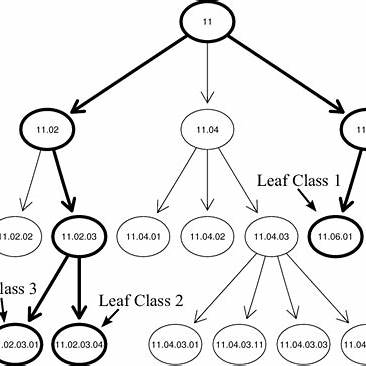
Which of the following data models enables us to arrange data files in the tree structure?
A. Network model
B. Relational model
C. Hierarchical model
D. None of the above
The correct answer and explanation is :
The correct answer is C. Hierarchical model.
Explanation:
The Hierarchical Data Model is designed to organize data in a tree-like structure, where data is arranged in a hierarchy. In this model, each record has a single parent, and there are one or more children, forming a parent-child relationship that resembles a tree. This structure is particularly useful when the data has a natural hierarchical order.
In the hierarchical model:
- Each record is represented by a node in the tree.
- Parent nodes can have multiple child nodes, but each child node can have only one parent.
- The hierarchy forms a tree structure, where the topmost node is the root, and each branch leads to data records (nodes) that can be considered subordinates.
Example:
A classic example of the hierarchical model is an organizational chart. At the top, you have the CEO (root node), under which there are several managers (child nodes), and beneath each manager, there are employee records (sub-child nodes).
Other Models:
- A. Network Model: The network model also represents data in a graph-like structure, but unlike the hierarchical model, it allows a more flexible many-to-many relationship. In the network model, nodes can have multiple parent nodes, and child nodes can have multiple parent nodes.
- B. Relational Model: The relational model organizes data into tables (or relations) and does not inherently represent hierarchical or tree-like structures. Data is linked through keys, not through a parent-child relationship.
- D. None of the above: Since the hierarchical model is the correct answer, this option is incorrect.
Visual Representation: