Managerial jobs with strategy-making responsibility are found only at the very top of the managerial hierarchy, although virtually all strategic decisions are subject to the review and approval of a company’s board of directors. They are relatively rare because most strategy-making is done by top-ranking executives and the members of a company’s board of directors.
They are typically limited to a company’s chief executive officer and chief strategy officer (who usually works closely with and reports directly to the chief executive officer).
They seldom exist within a functional department (e.g., marketing and sales) or in an operating unit (a plant or a district office) because these levels of the organization structure are well below the level where strategic decisions are typically made.
They exist at many levels of the organizational structure of a large corporation when its operations cut across different products, industries, and geographical areas.
The correct answer and explanation is:
Correct Answer:
They exist at many levels of the organizational structure of a large corporation when its operations cut across different products, industries, and geographical areas.
Explanation:
In large corporations with diverse operations across multiple industries, product lines, or geographic regions, strategic decision-making is not confined to just the highest executive levels. Instead, strategy-making responsibility is distributed across multiple managerial levels to ensure effective decision-making at different business units and divisions.
- Decentralized Strategy-Making
- Large multinational corporations (MNCs) often decentralize their strategic decision-making to business unit leaders, regional managers, and even functional heads.
- This allows different parts of the organization to develop and execute strategies aligned with local market conditions while staying within the company’s overall strategic framework.
- Corporate, Business, and Functional Strategies
- Corporate-level strategy is decided by top executives (CEO, Board of Directors, and CSO).
- Business-level strategy is set by division heads or general managers who oversee specific product lines or industries.
- Functional-level strategy is determined by department heads (e.g., marketing, operations) within each business unit.
- Geographical Strategy-Making
- Global businesses have regional executives responsible for crafting and executing strategies based on regional consumer behavior, regulatory environments, and competition.
- Flexibility and Responsiveness
- Having strategy-making responsibilities at multiple levels ensures that businesses respond quickly to market changes and industry trends.
This distributed approach to strategy-making helps large corporations achieve agility, competitiveness, and sustained growth in a dynamic global business environment.
Image Generation:
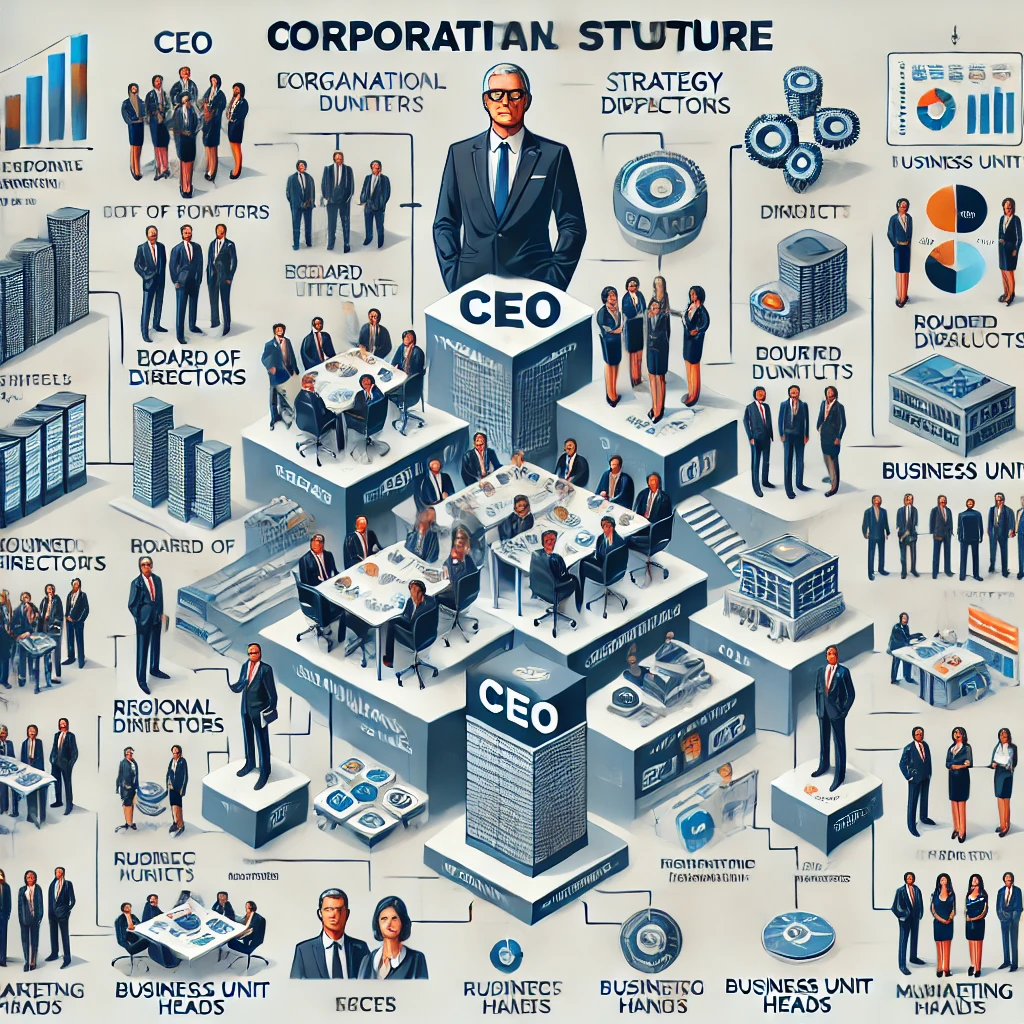
I’ll generate an image of a corporate organizational structure, highlighting multiple levels of strategy-making across different business units, geographical regions, and product lines.
Here’s an image illustrating a corporate organizational structure with multiple levels of strategy-making. It highlights how different business units, regional managers, and functional departments contribute to strategic decisions in a large corporation. Let me know if you’d like any modifications!