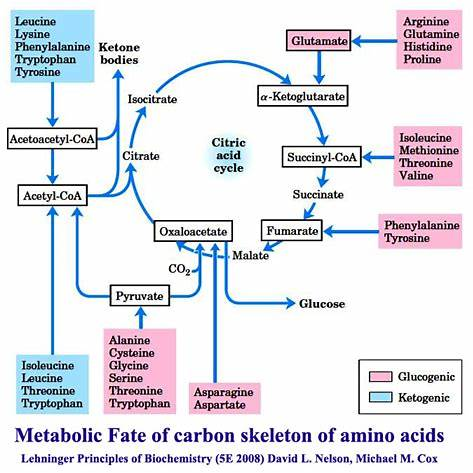
.Substances to which amino acid carbon “skeletons” may be degraded include
a.acetyl CoA
b.citrate
c.succinate
d.more than one correct response
e.no correct response
The correct answer and explanation is :
The correct answer is:
d. More than one correct response
Explanation:
Amino acid carbon skeletons can be degraded into multiple metabolic intermediates, depending on the specific amino acid. These intermediates feed into various metabolic pathways, including the citric acid (Krebs) cycle and fatty acid synthesis.
1. Acetyl CoA (Correct)
- Certain amino acids, such as leucine, isoleucine, lysine, phenylalanine, tryptophan, and tyrosine, can be converted into acetyl CoA.
- Acetyl CoA plays a crucial role in energy production (ATP synthesis via oxidative phosphorylation) and lipid biosynthesis.
- It can enter the Krebs cycle or be used for ketone body formation.
2. Citrate (Incorrect)
- Citrate is an intermediate in the Krebs cycle, but amino acids do not directly degrade into citrate.
- Instead, acetyl CoA can combine with oxaloacetate to form citrate, making citrate a secondary product rather than a direct degradation product of amino acids.
3. Succinate (Correct)
- Amino acids such as methionine, isoleucine, and valine can be converted into propionyl CoA, which is further converted into succinyl CoA, an intermediate in the Krebs cycle.
- Succinyl CoA is important for ATP production and gluconeogenesis.
Since both acetyl CoA and succinate are correct, the best answer is “d. More than one correct response.”
Importance of Amino Acid Degradation
- This process helps generate energy when glucose levels are low.
- It allows for the production of metabolic intermediates that support various cellular functions.
- Some amino acids are glucogenic, ketogenic, or both, depending on which intermediates they produce.