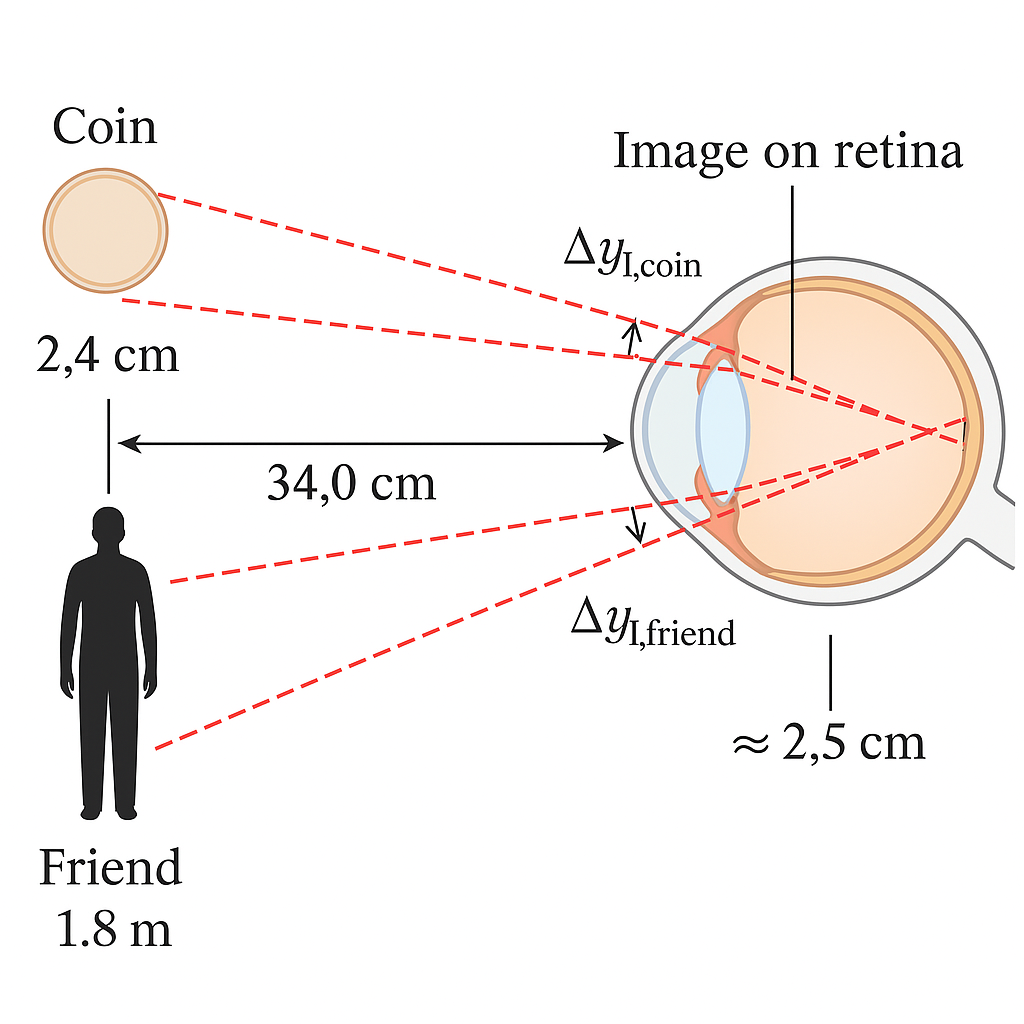
A typical human eye is nearly spherical, and is usually about 2.5 cm in diameter. Suppose a person first looks at a coin that is 2.4 cm in diameter and located 34.0 cm from her eye. Then, she looks up at a friend who is 1.8 m tall and 4.00 m away. Find the magnitude of the approximate size of each image (coin ℎI,coin and friend ℎI,friend) on her retina. (Hint: Just consider rays from the top and bottom of the object that pass through the center of the lens.)
b) Are the images on her retina upright/inverted and/or virtual/real?
The correct answer and explanation is:
To find the approximate size of each image on the retina, we can use the concept of similar triangles. When light rays pass through the eye’s lens and converge onto the retina, they form a real, inverted image.
a) Image Size Calculation
The image size can be calculated using the formula: hiho=dido\frac{h_i}{h_o} = \frac{d_i}{d_o}
Where:
- hih_i = Height of the image on the retina
- hoh_o = Actual height of the object
- did_i = Distance from the lens to the retina (about 2.5 cm)
- dod_o = Distance from the lens to the object
For the Coin:
- ho=2.4h_o = 2.4 cm
- do=34.0d_o = 34.0 cm
- di=2.5d_i = 2.5 cm
hi=ho×dido=2.4×2.534.0≈0.176 cmh_i = h_o \times \frac{d_i}{d_o} = 2.4 \times \frac{2.5}{34.0} \approx 0.176 \text{ cm}
For the Friend:
- ho=180h_o = 180 cm
- do=400d_o = 400 cm
- di=2.5d_i = 2.5 cm
hi=180×2.5400≈1.125 cmh_i = 180 \times \frac{2.5}{400} \approx 1.125 \text{ cm}
b) Nature of Images
The images formed on the retina are real and inverted.
- Real Image: The lens of the eye is a converging lens. Light rays from the object are focused by the lens to form an image on the retina, meaning the image is a physical reproduction of the object formed by the convergence of light rays.
- Inverted Image: Due to the lens’s nature, the images formed are upside down. This is corrected by the brain, which processes the visual information to make sense of the world right-side-up.
The formation of the image is analogous to a camera where the lens focuses light onto a film or sensor. The eye’s lens bends incoming light rays, causing them to converge at the retina. Because of the curvature and placement of the lens, the resulting image is inverted. The brain later interprets these signals as an upright view, thanks to complex neural processing.
I’ll generate a diagram illustrating these concepts next.
Got it.