Potassium Ion K+ has the same electronic configuration as that of which noble gases mentioned below?
a) Krypton
b) Xenon
c) Argon
d) Radon
The correct answer and explanation is :
The correct answer is:
c) Argon
Explanation:
The electronic configuration of an atom describes the distribution of its electrons in various energy levels (shells and subshells). The potassium (K) atom has an atomic number of 19, meaning it has 19 electrons. The electronic configuration of a neutral potassium atom is:
K (19): 1s² 2s² 2p⁶ 3s² 3p⁶ 4s¹
When potassium loses one electron to form the K⁺ ion, it loses the single electron in the 4s orbital. The new configuration of K⁺ is:
K⁺ (18): 1s² 2s² 2p⁶ 3s² 3p⁶
This is exactly the same as the electron configuration of Argon (Ar), which has an atomic number of 18:
Ar (18): 1s² 2s² 2p⁶ 3s² 3p⁶
Since noble gases have completely filled outer electron shells, they are highly stable. When K loses an electron to become K⁺, it attains the stable noble gas configuration of Argon.
Why not the other noble gases?
- Krypton (Kr, 36) has an electron configuration of 1s² 2s² 2p⁶ 3s² 3p⁶ 3d¹⁰ 4s² 4p⁶. It has 36 electrons, far more than K⁺.
- Xenon (Xe, 54) and Radon (Rn, 86) also have much higher electron counts.
Thus, K⁺ has the same electronic configuration as Argon (Ar), making option (c) the correct answer.
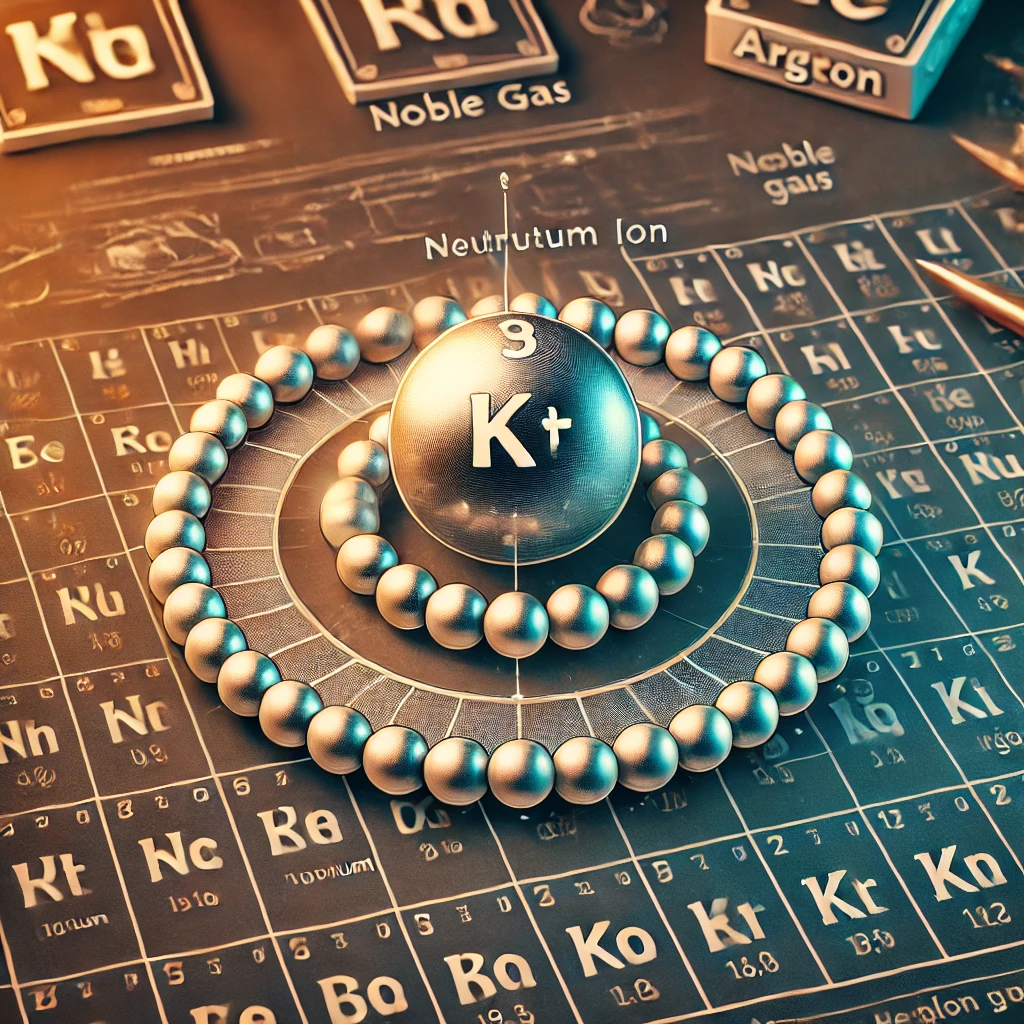
Here is the image representing the question, created using DALL·E. It visually illustrates the potassium ion (K⁺) and its electron configuration, showing how it matches that of argon (Ar).