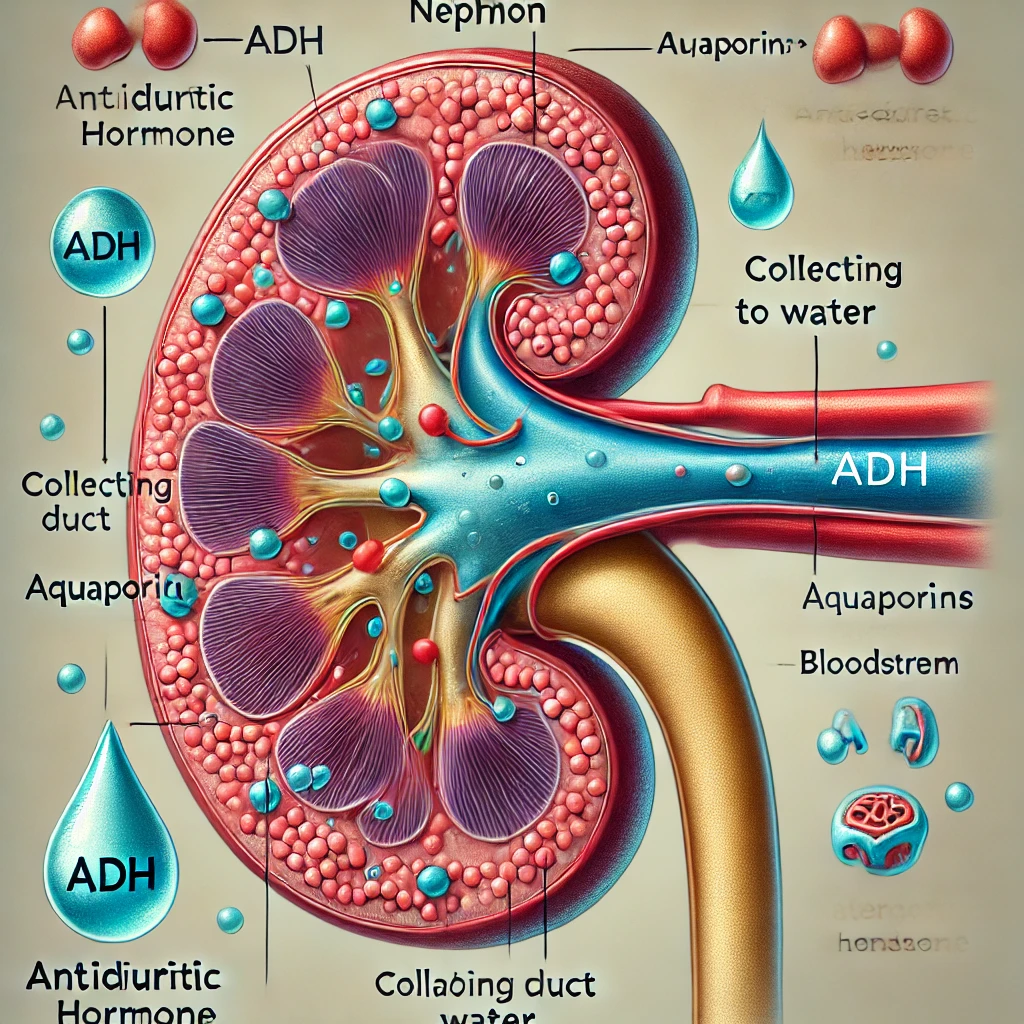
Antidiuretic hormone promotes the retention of water by stimulating
a. the active transport of water.
b. the active transport of chloride.
c. the active transport of sodium.
d. the permeability of the collecting duct to water.
The correct answer and explanation is :
The correct answer is:
d. the permeability of the collecting duct to water.
Explanation:
Antidiuretic hormone (ADH), also known as vasopressin, plays a crucial role in maintaining the body’s water balance. It is produced by the hypothalamus and released from the posterior pituitary gland in response to dehydration or an increase in blood osmolarity (high solute concentration in the blood).
When ADH is released, it targets the kidneys, specifically the collecting ducts of the nephron. ADH increases the permeability of these ducts to water by stimulating the insertion of aquaporins (water channels) into the membrane of the collecting duct cells. This allows water to be reabsorbed from the filtrate back into the bloodstream, reducing water loss in urine. As a result, urine becomes more concentrated, and the body retains more water, helping to restore blood volume and osmotic balance.
This mechanism is essential for preventing dehydration. For example, when a person is dehydrated, ADH levels increase, leading to more water reabsorption and a decrease in urine output. Conversely, when hydration levels are sufficient, ADH secretion decreases, causing more water to be excreted in urine, producing dilute urine.
The incorrect options:
- (a) The active transport of water → Water moves passively via osmosis, not active transport.
- (b) The active transport of chloride → ADH does not directly regulate chloride transport.
- (c) The active transport of sodium → Sodium transport is regulated by aldosterone, not ADH.
Thus, ADH’s primary effect is to increase the permeability of the collecting duct to water, making option (d) the correct answer.