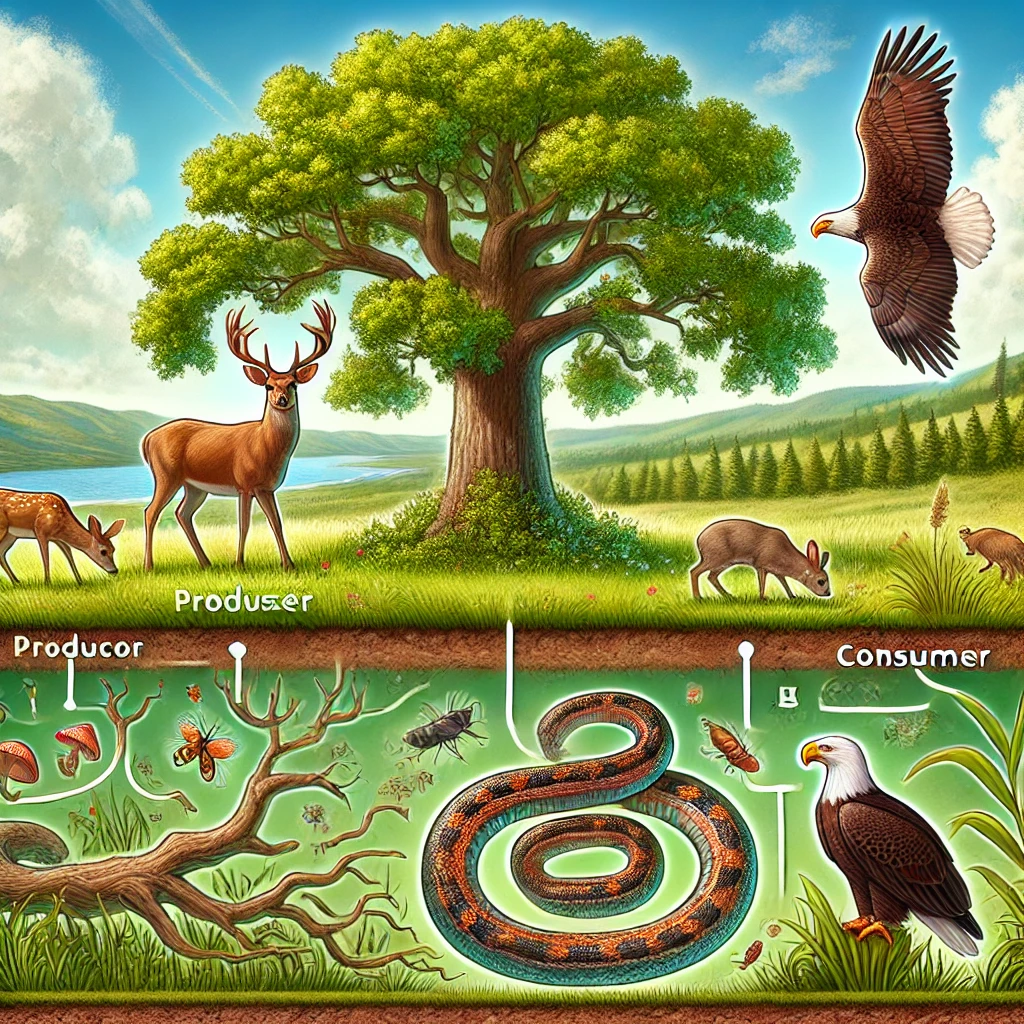
Match the following descriptions with the appropriate trophic level.
- Oak trees – Primary producers
- Deer – Primary consumers
- Bald eagle – Secondary consumers
- Small snake species – Tertiary consumers
Make their own food – Photosynthesizers
Herbivores – Consume producers
Primary carnivores – Secondary carnivores
The correct answer and explanation is:
Correct Answer:
- Oak trees – Primary producers
- Deer – Primary consumers
- Bald eagle – Tertiary consumers
- Small snake species – Secondary consumers
- Make their own food – Photosynthesizers
- Herbivores – Consume producers
- Primary carnivores – Secondary consumers
Explanation:
In an ecosystem, organisms are classified into different trophic levels based on their role in the food chain.
- Primary Producers (Oak trees) – These organisms, mainly plants and algae, produce their own food using sunlight through photosynthesis. Oak trees fall into this category as they convert sunlight into energy, providing a food source for herbivores.
- Primary Consumers (Deer) – These are herbivores that feed on primary producers. Deer consume leaves, grass, and other vegetation, making them primary consumers.
- Secondary Consumers (Small snake species) – These organisms primarily eat herbivores. Small snakes often feed on insects, rodents, or small animals, placing them in the secondary consumer category.
- Tertiary Consumers (Bald eagle) – These are predators that feed on secondary consumers. Bald eagles, being apex predators, consume fish, small mammals, and even other birds, making them tertiary consumers.
- Photosynthesizers (Make their own food) – These are organisms like plants, algae, and certain bacteria that perform photosynthesis, using sunlight, water, and carbon dioxide to produce food and oxygen.
- Consume Producers (Herbivores) – Herbivores rely on plants for sustenance. They are an essential part of the food chain, transferring energy from producers to higher trophic levels.
- Secondary Consumers (Primary carnivores) – These are animals that eat primary consumers. Small snakes, foxes, and some birds of prey fall into this category, consuming herbivores for sustenance.
Each level plays a crucial role in maintaining the balance of an ecosystem. The removal or decline of one trophic level can disrupt the entire food web.
Here is an AI-generated illustration showcasing different trophic levels in an ecosystem. It visually represents the roles of primary producers, consumers, and top predators. Let me know if you’d like any modifications!