The Law Of Motion Of Aggregate Capital In The Solow Model Is Given: K4+1 = (1 -5 )K, +S: F(K,,L) = Derive The Law Of Motion Of Capital Per Worker.
The correct answer and explanation is:
The law of motion for aggregate capital in the Solow model is given by: Kt+1=(1−δ)Kt+sF(Kt,Lt)K_{t+1} = (1 – \delta)K_t + sF(K_t, L_t)
To derive the law of motion for capital per worker (ktk_t), we define: kt=KtLtk_t = \frac{K_t}{L_t}
where ktk_t represents capital per worker and LtL_t represents the labor force. Assuming labor grows at rate nn, we have: Lt+1=(1+n)LtL_{t+1} = (1 + n)L_t
Dividing both sides of the aggregate capital equation by Lt+1L_{t+1}: Kt+1Lt+1=(1−δ)Kt+sF(Kt,Lt)(1+n)Lt\frac{K_{t+1}}{L_{t+1}} = \frac{(1 – \delta)K_t + sF(K_t, L_t)}{(1 + n)L_t}
Using kt+1=Kt+1Lt+1k_{t+1} = \frac{K_{t+1}}{L_{t+1}} and kt=KtLtk_t = \frac{K_t}{L_t}, we rewrite: kt+1=(1−δ)Kt+sF(Kt,Lt)(1+n)Ltk_{t+1} = \frac{(1 – \delta)K_t + sF(K_t, L_t)}{(1 + n)L_t}
Using the per-worker production function yt=f(kt)=F(Kt,Lt)Lty_t = f(k_t) = \frac{F(K_t, L_t)}{L_t}, we get: kt+1=(1−δ)ktLt+sf(kt)Lt(1+n)Ltk_{t+1} = \frac{(1 – \delta) k_t L_t + s f(k_t) L_t}{(1 + n)L_t}
Canceling LtL_t: kt+1=(1−δ)kt+sf(kt)1+nk_{t+1} = \frac{(1 – \delta) k_t + s f(k_t)}{1 + n}
Explanation:
This equation represents the law of motion for capital per worker in the Solow model. It shows how capital per worker evolves over time, influenced by three key factors:
- Depreciation (δ\delta): Capital stock loses value over time, reducing the amount of capital available in the next period.
- Savings (ss): A fraction of output is saved and reinvested in new capital, increasing capital accumulation.
- Labor growth (nn): As the population grows, the same capital stock is distributed among more workers, reducing capital per worker.
In equilibrium, capital per worker stabilizes at the steady-state level where kt+1=ktk_{t+1} = k_t. This means the economy reaches a point where new investments just offset depreciation and labor force growth.
This equation is central to the Solow model, explaining long-term economic growth driven by capital accumulation and technological progress.
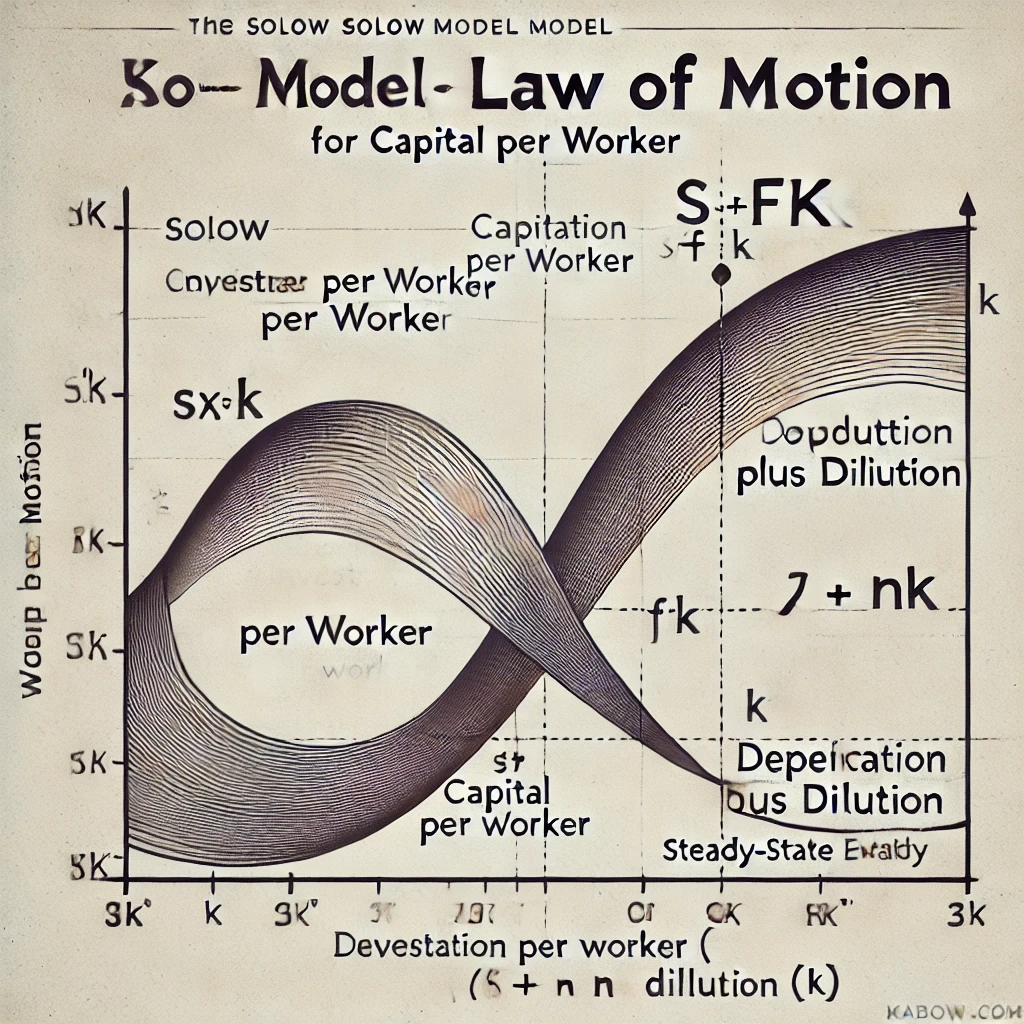
Now, generating an image that visually represents the Solow model’s law of motion for capital per worker.
Here is an image illustrating the Solow model’s law of motion for capital per worker. It visually represents how investment per worker and depreciation plus dilution interact to determine the steady-state equilibrium. Let me know if you need any modifications!