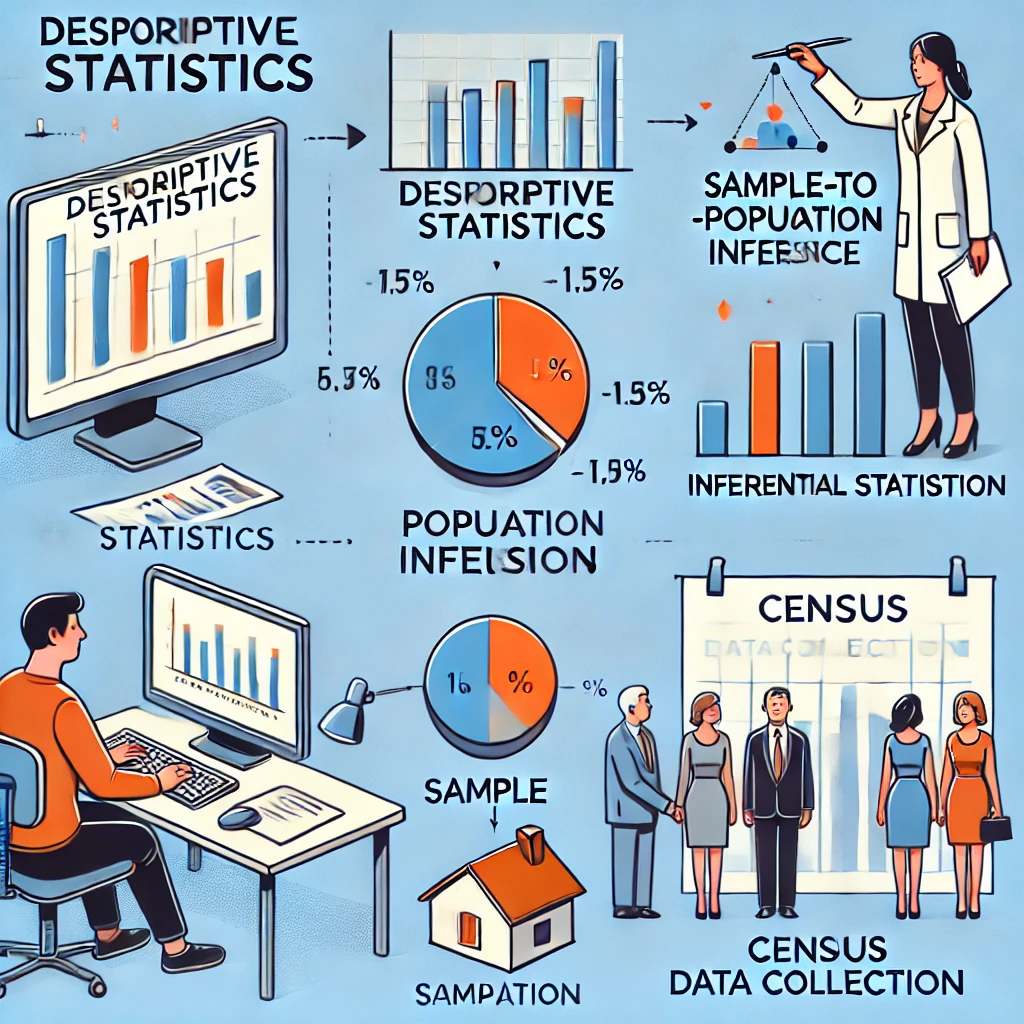
True or False
Indicate whether each of the following statements is true or false:
a. Statistics is the science of collecting, organizing, analyzing, interpreting, and presenting data.
b. A statistic is a single measure, reported as a number, used to summarize a sample data set.
c. Descriptive statistics refers to generalizing from a sample to a population, estimating unknown parameters, drawing conclusions, and making decisions.
d. One of the advantages of censuses is that they provide up-to-date data.
e. Inferential statistics refers to the collection, organization, presentation, and summary of data, either by using charts and graphs or through numerical summaries.
The correct answer and explanation is :
Here are the correct answers along with explanations:
a. True
Statistics is indeed the science of collecting, organizing, analyzing, interpreting, and presenting data. It helps in making informed decisions by transforming raw data into meaningful information. This process is used in various fields such as healthcare, business, and social sciences.
b. True
A statistic is a single numerical measure used to summarize a sample data set. For example, the average test score of a group of students is a statistic because it summarizes the data collected from the sample rather than the entire population.
c. False
Descriptive statistics does not involve generalization or inference. Instead, it focuses on summarizing and presenting data in a meaningful way using tables, graphs, and numerical measures such as mean, median, and standard deviation. The statement given describes inferential statistics.
d. False
Censuses aim to gather data on an entire population, but they may not always provide up-to-date data because they are conducted periodically (e.g., every 10 years). By the time census data is analyzed and published, the information may already be outdated.
e. False
Inferential statistics is about making predictions and generalizations from sample data to a larger population. It involves estimating population parameters, hypothesis testing, and confidence intervals. The statement provided describes descriptive statistics, not inferential statistics.
Explanation:
Statistics is divided into descriptive and inferential statistics. Descriptive statistics summarizes and organizes data, whereas inferential statistics helps make conclusions about a larger population based on a sample. Censuses collect data from an entire population but may become outdated. Understanding the distinction between descriptive and inferential statistics is crucial for accurate data interpretation and decision-making.