which of the following statements best describes gravity?
a. the force that holds an electron in the atom.
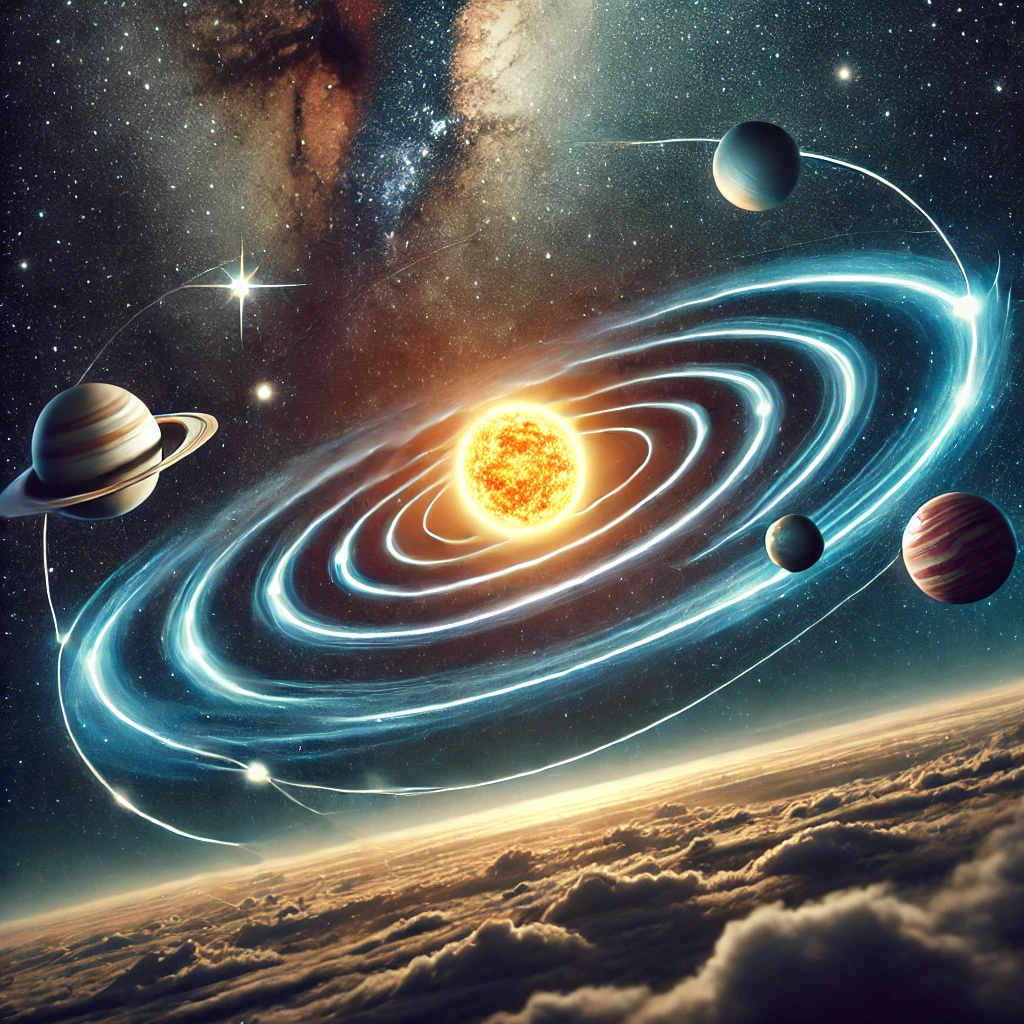
b. the force that holds planets in orbit around a star.
c. the force at work when quarks change type.
d. the force that hold protons and neutrons together in an atoms nucleus. Chegg
The correct answer and explanation is :
Correct Answer:
b. The force that holds planets in orbit around a star.
Explanation:
Gravity is a fundamental force of nature that governs the motion of objects with mass. It is the force responsible for attracting objects toward one another, and its effects are most evident on a large scale, such as in the movement of planets, stars, and galaxies.
Newton’s Law of Universal Gravitation states that every mass in the universe attracts every other mass with a force that is proportional to the product of their masses and inversely proportional to the square of the distance between them. This principle explains why planets orbit stars, including why Earth orbits the Sun.
Albert Einstein’s General Theory of Relativity further refined our understanding of gravity by describing it as the curvature of space-time caused by massive objects. According to this theory, planets follow curved paths around stars due to distortions in space-time rather than being “pulled” in a classical sense.
Now, let’s examine why the other answer choices are incorrect:
- (a) The force that holds an electron in the atom – This is actually the electromagnetic force. The negatively charged electrons are attracted to the positively charged nucleus due to electrostatic interactions.
- (c) The force at work when quarks change type – This refers to the weak nuclear force, which is responsible for processes like beta decay, not gravity.
- (d) The force that holds protons and neutrons together in an atom’s nucleus – This describes the strong nuclear force, which counteracts the repulsive electromagnetic force between protons.
Thus, gravity primarily governs large-scale cosmic interactions, including planetary orbits, making option (b) the correct answer.