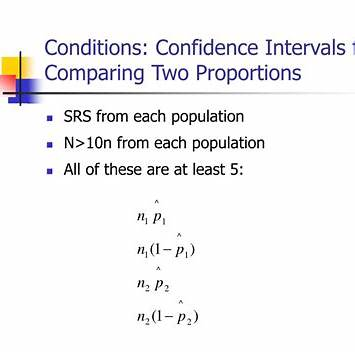
The success/failure condition for a confidence interval for proportions requires there to be:
at least 10 success and at least 10 failures
at most 10 success and at most 10 failures
The correct answer and explanation is :
The correct answer is at least 10 successes and at least 10 failures.
Explanation:
In statistics, when constructing a confidence interval for proportions, one of the assumptions involves the sample size and the distribution of successes and failures. The success/failure condition is a rule of thumb used to ensure that the sample data meet the requirements for the confidence interval to be approximately normally distributed. This is important because most methods for constructing confidence intervals for proportions rely on the normal distribution as an approximation.
For a proportion to have a reasonable normal approximation, the sample should contain enough successes and failures. The success/failure condition requires that both the number of successes (denoted as xx) and the number of failures (denoted as n−xn – x, where nn is the total sample size) be sufficiently large.
Why is this condition important?
- Central Limit Theorem: The central limit theorem states that as the sample size increases, the sampling distribution of the sample proportion approaches a normal distribution. However, for this to occur reliably, we need a large enough number of successes and failures to prevent the binomial distribution from being too skewed or discrete.
- Sample size considerations: If there are fewer than 10 successes or fewer than 10 failures, the normal approximation to the binomial distribution may not hold, which would make the confidence interval inaccurate or misleading. A sample that has too few successes or failures would result in a skewed distribution, violating the assumptions of normality needed for inference.
Mathematical basis:
For a sample size nn and a sample proportion p^=xn\hat{p} = \frac{x}{n}, the normal approximation holds well when:
- np^≥10n \hat{p} \geq 10 (at least 10 successes),
- n(1−p^)≥10n (1 – \hat{p}) \geq 10 (at least 10 failures).
These conditions ensure that both tails of the distribution are sufficiently populated, making the approximation to the normal distribution valid.