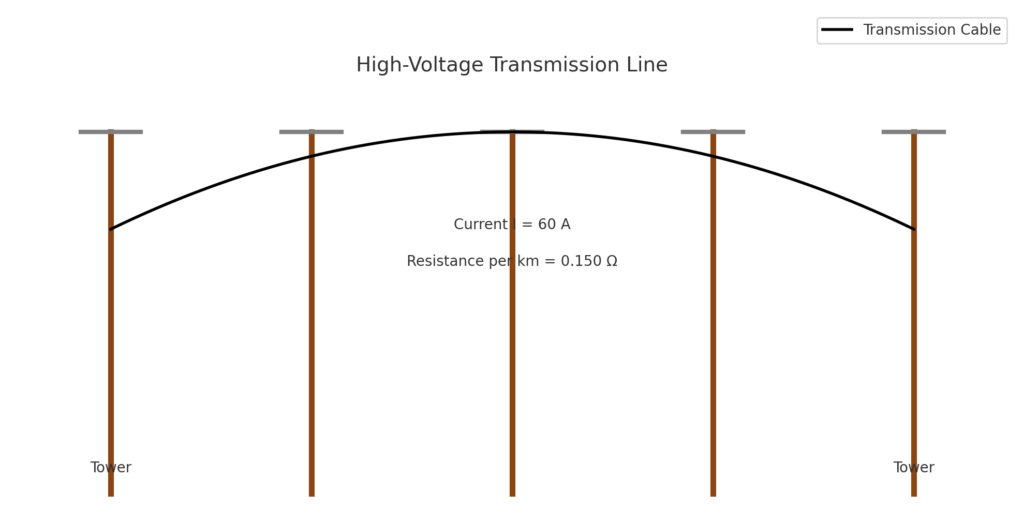
Copper and aluminum are being considered for a high-voltage transmission line that must carry a current of 60.0 A. The resistance per unit length is to be 0.150 Ω /km. The densities of copper and aluminum are 3960 and 2600 kg/m3, respectively. Compute (a) the magnitude J of the current density and (b) the mass per unit length), for a copper cable and (c) / and (d) λ for an aluminum cable.
The correct answer and explanation is :
(a) Current Density ( J ) and (b, d) Mass per Unit Length ( \lambda )
We are given:
- Current ( I = 60.0 \, \text{A} )
- Resistance per unit length ( R/L = 0.150 \, \Omega/\text{km} = 0.150 \times 10^{-3} \, \Omega/\text{m} )
- Resistivity:
- Copper: ( \rho_{\text{Cu}} = 1.68 \times 10^{-8} \, \Omega\cdot\text{m} )
- Aluminum: ( \rho_{\text{Al}} = 2.82 \times 10^{-8} \, \Omega\cdot\text{m} )
- Densities:
- Copper: ( \rho_{\text{m,Cu}} = 8960 \, \text{kg/m}^3 )
- Aluminum: ( \rho_{\text{m,Al}} = 2600 \, \text{kg/m}^3 )
Step-by-Step Calculations
Common Step: Area of cross-section
Use resistance per unit length ( R/L = \rho / A )
Thus, ( A = \rho / (R/L) )
- Copper Area:
[
A_{\text{Cu}} = \frac{1.68 \times 10^{-8}}{0.150 \times 10^{-3}} = 1.12 \times 10^{-4} \, \text{m}^2
] - Aluminum Area:
[
A_{\text{Al}} = \frac{2.82 \times 10^{-8}}{0.150 \times 10^{-3}} = 1.88 \times 10^{-4} \, \text{m}^2
]
(a) Current Density ( J = I/A )
- Copper:
[
J_{\text{Cu}} = \frac{60}{1.12 \times 10^{-4}} = 5.36 \times 10^5 \, \text{A/m}^2
] - Aluminum:
[
J_{\text{Al}} = \frac{60}{1.88 \times 10^{-4}} = 3.19 \times 10^5 \, \text{A/m}^2
]
(b) and (d) Mass per Unit Length ( \lambda = A \times \text{density} )
- Copper:
[
\lambda_{\text{Cu}} = 1.12 \times 10^{-4} \times 8960 = 1.00 \, \text{kg/m}
] - Aluminum:
[
\lambda_{\text{Al}} = 1.88 \times 10^{-4} \times 2600 = 0.489 \, \text{kg/m}
]
Summary
| Material | ( J ) (A/m²) | ( \lambda ) (kg/m) |
|---|---|---|
| Copper | ( 5.36 \times 10^5 ) | 1.00 |
| Aluminum | ( 3.19 \times 10^5 ) | 0.489 |