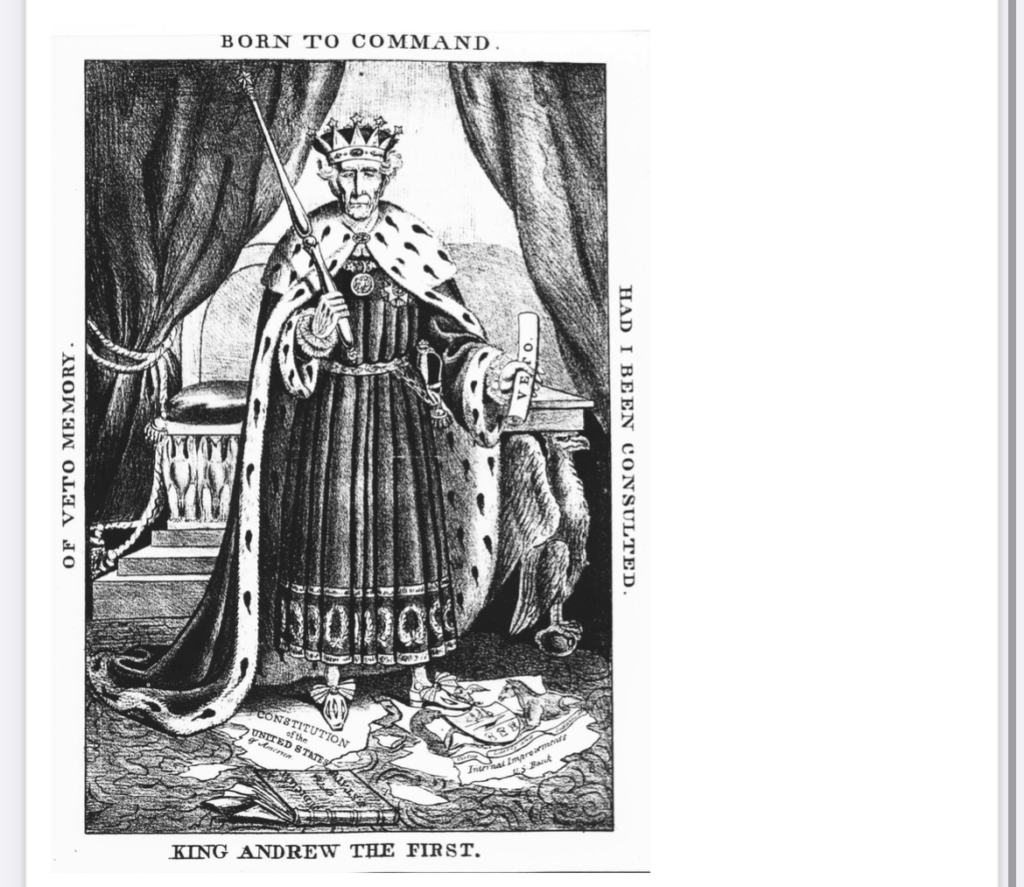
According to this political cartoon, why was Andrew Jackson depicted as a tyrant by his opponents?
The correct answer and explanation is :
Correct Answer:
Andrew Jackson was depicted as a tyrant by his opponents because they believed he abused presidential powers, especially by vetoing the recharter of the Bank of the United States and ignoring Supreme Court decisions, acting more like a king than a president.
300-Word Explanation:
In the political cartoon linked, Andrew Jackson is portrayed in royal attire, wearing a crown and holding a scepter, standing atop a shredded U.S. Constitution. This dramatic imagery reflects how his political opponents viewed him—not as a democratic leader, but as a tyrant or monarch who disrespected the limits of his authority.
One major reason Jackson was seen as tyrannical was his opposition to the Second Bank of the United States. He believed the Bank was a tool of the elite and harmful to the common people. In 1832, he vetoed the bill to recharter the Bank, despite strong support from Congress and the public. Critics argued that Jackson overstepped his role by using the veto power so aggressively, not just on constitutional grounds, but based on personal and political disagreements. This was seen as an abuse of executive power.
Another source of criticism was Jackson’s response to the Supreme Court’s ruling in Worcester v. Georgia (1832), which stated that the state of Georgia could not impose laws on Cherokee tribal lands. Jackson reportedly ignored the decision, allowing Georgia to proceed with actions that led to the Trail of Tears. His opponents claimed that by refusing to enforce a Supreme Court ruling, Jackson showed blatant disregard for the judicial branch and the rule of law.
Altogether, the cartoon reflects fears that Jackson was undermining the system of checks and balances. By acting independently of the other branches of government and consolidating power in the executive office, he earned the nickname “King Andrew I” from critics who feared he was behaving like a monarch, not a democratically elected president.