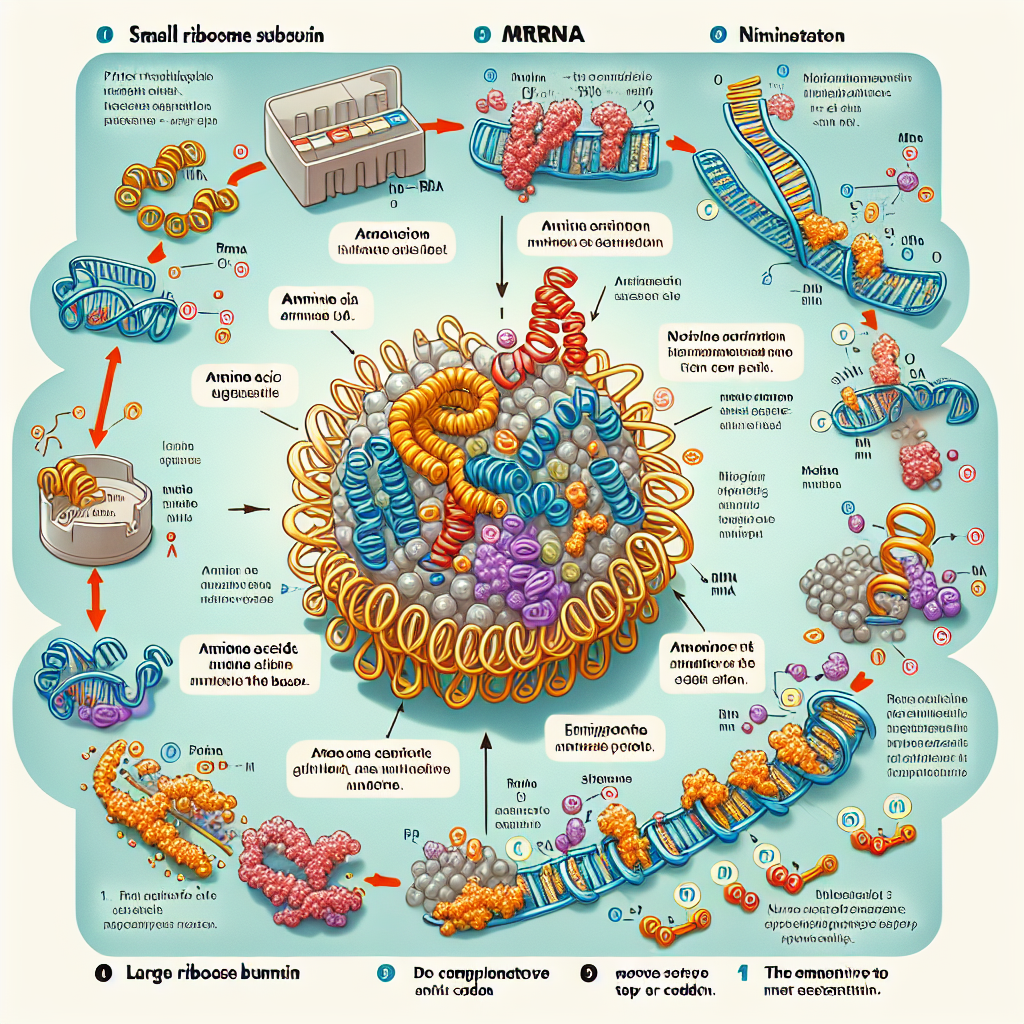
Order the steps of translation from beginning to end.
Small subunits bind to mRNA
Elongation steps are repeated building a protein one aa at a time
The complex moves down 3 bases on the mRNA
The tRNA, whose anticodon compliments the second mRNA codon enters and sites in the second site
The stop codon is reached.
Large subunit of ribosome binds to mRNA with met tRNA in the first open site
There is no complimentary tRNA to match the stop codon and the complex falls apart releasing a new protein
The tRNA without the amino acid (the empty tRNA) leaves the first open site
Initiator tRNA carrying a Met (methionine) amino acids binds to mRNA
The amino acids from the 1stRNA binds to the amino acid of the 2nd tRNA.
The correct answer and explanation is :
Correct Order of Translation Steps (Beginning to End):
- Small subunit binds to mRNA
- Initiator tRNA carrying a Met (methionine) amino acid binds to mRNA
- Large subunit of ribosome binds to mRNA with met tRNA in the first open site
- The tRNA, whose anticodon complements the second mRNA codon, enters and sits in the second site
- The amino acid from the 1st tRNA binds to the amino acid of the 2nd tRNA
- The tRNA without the amino acid (the empty tRNA) leaves the first open site
- The complex moves down 3 bases on the mRNA
- Elongation steps are repeated, building a protein one amino acid at a time
- The stop codon is reached
- There is no complementary tRNA to match the stop codon and the complex falls apart releasing a new protein
Explanation (Approx. 300 Words):
Translation is the process by which ribosomes synthesize proteins using messenger RNA (mRNA) as a template. This process occurs in three main stages: initiation, elongation, and termination.
In the initiation phase, the small ribosomal subunit binds to the mRNA near the start codon (AUG). The initiator tRNA carrying methionine (Met) recognizes the start codon through complementary base pairing with its anticodon. Then, the large ribosomal subunit attaches, creating a complete ribosome with the initiator tRNA in the first site, called the P site.
During elongation, a second tRNA, whose anticodon matches the next mRNA codon, enters the A site of the ribosome. The amino acid from the tRNA in the P site is transferred and forms a peptide bond with the amino acid on the tRNA in the A site. The ribosome then shifts (translocates) three bases down the mRNA, moving the tRNAs into new positions: the empty tRNA moves to the E site and exits, while the tRNA with the growing peptide chain moves to the P site. These elongation steps repeat, adding amino acids one at a time to the growing chain.
The termination phase begins when the ribosome encounters a stop codon (UAA, UAG, or UGA). No tRNA can bind to the stop codon, so a release factor binds instead. This causes the ribosome complex to disassemble, releasing the newly synthesized protein into the cell.
This highly coordinated sequence ensures accurate and efficient protein synthesis essential for all cellular functions.