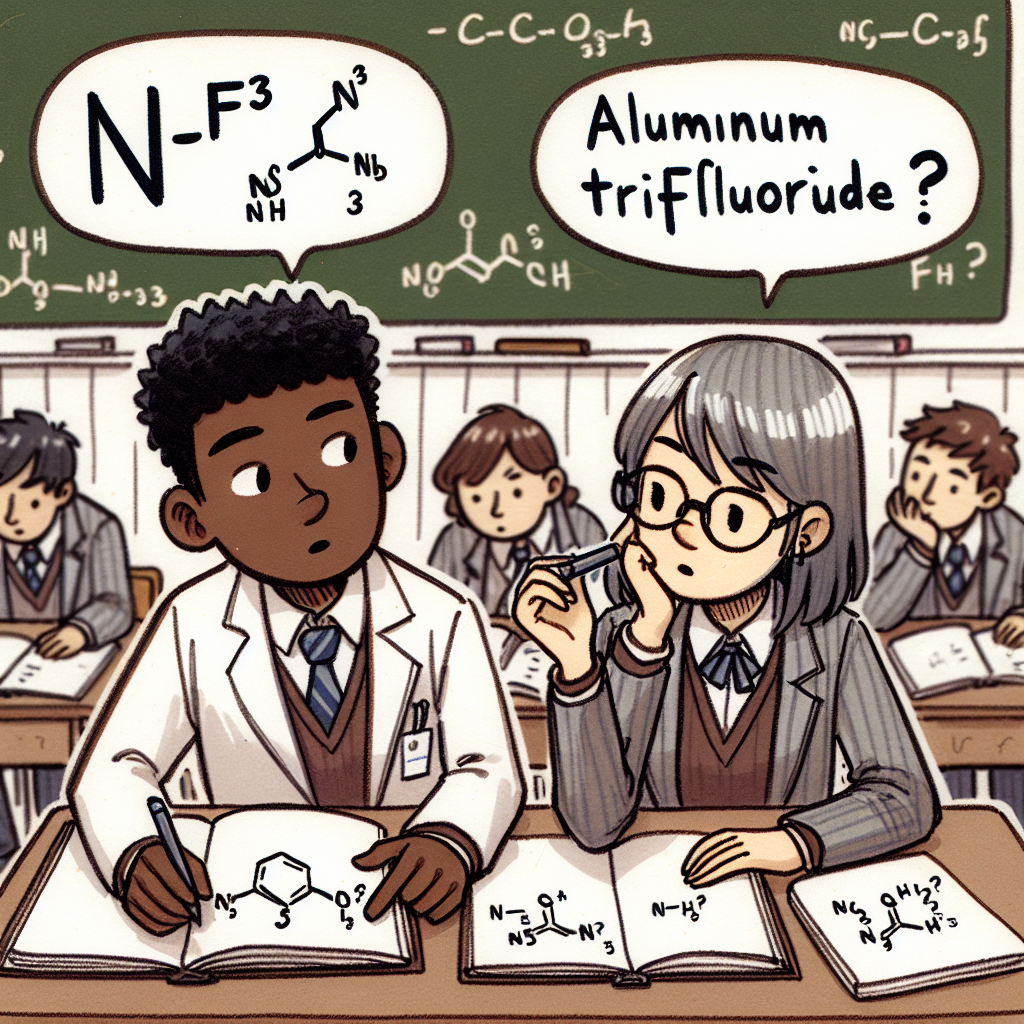
You are explaining the rules of nomenclature to a friend. You state the name of the compound NF3 as nitrogen trifluoride. Your friend says, “Oh, so AlF3 must be aluminum trifluoride.” Is your friend correct? Explain. (3 points)
The correct answer and explanation is :
Your friend is incorrect. The correct name for AlF3 is aluminum fluoride, not aluminum trifluoride. The naming conventions in chemistry follow specific rules based on the type of compound. Here’s a detailed explanation:
Explanation:
The confusion stems from the way chemical compounds are named. When naming molecular compounds, we use prefixes to indicate the number of atoms of each element in the molecule. However, these prefixes are typically only used for binary molecular compounds, where both elements are nonmetals. This is why NF3 is called nitrogen trifluoride — because both nitrogen and fluorine are nonmetals and there are three fluorine atoms in the molecule. The prefix “tri-“ indicates three fluorine atoms.
However, the naming conventions differ when it comes to ionic compounds, which is what AlF3 is. AlF3 consists of aluminum (a metal) and fluorine (a nonmetal), and it is an ionic compound, not a molecular compound. In ionic compounds, we typically do not use prefixes to indicate the number of atoms. Instead, the name reflects the cation (positive ion) and the anion (negative ion).
- Aluminum (Al) forms a +3 charge (Al^3+), and fluorine (F) forms a -1 charge (F^-) when it becomes an anion.
- To balance the charges in AlF3, three fluoride ions (F-) are needed to balance one aluminum ion (Al^3+).
- The compound is therefore called aluminum fluoride, where the number of fluoride ions is understood based on the charges of the ions and the stoichiometry of the compound, and no prefixes are needed.
Conclusion:
In short, AlF3 is aluminum fluoride, not aluminum trifluoride, because it is an ionic compound, and naming conventions for ionic compounds do not use numerical prefixes. Prefixes like “tri-” are reserved for binary molecular compounds, where both elements are nonmetals. Therefore, your friend’s assumption is incorrect.