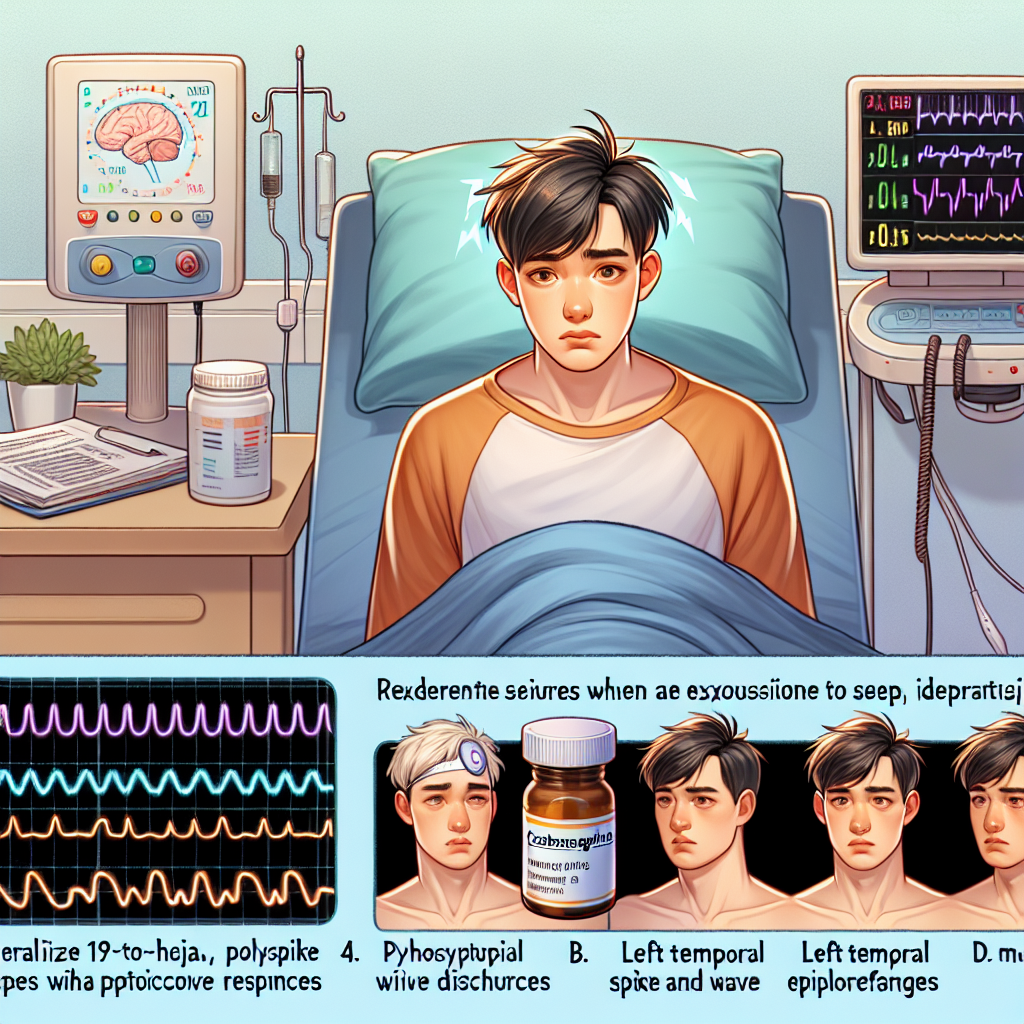
A 19-year-old man presents with intractable generalized tonic-clonic (GTC) seizures, which worsen with sleep deprivation. He also reports morning twitching and jerks while taking carbamazepine. Additionally, he experienced muscle twitching during his EEG when exposed to flashing lights.
a. What are the expected EEG findings?
Choose the correct option:
A. Generalized 4- to 6-Hertz (Hz) polyspike and wave discharges with a photoconvulsive response
B. Generalized 3-Hz spike and wave discharges
C. Generalized 2.0-Hz spike and wave discharges
D. Left temporal focal epileptiform discharges
b. What is the next step in treatment?
Choose the correct option:
A. Add phenytoin.
B. Change carbamazepine to oxcarbazepine.
C. Change from carbamazepine to levetiracetam.
D. Continue carbamazepine and add levetiracetam.
The correct answer and explanation is :
Correct Answers:
a. A. Generalized 4- to 6-Hertz (Hz) polyspike and wave discharges with a photoconvulsive response
b. C. Change from carbamazepine to levetiracetam
Explanation:
This 19-year-old man presents with features classic for Juvenile Myoclonic Epilepsy (JME), a type of idiopathic generalized epilepsy. Key clinical features include:
- Onset in adolescence (usually between ages 12–18)
- Generalized tonic-clonic seizures (GTCs), especially worsened by sleep deprivation
- Morning myoclonic jerks, especially of the upper limbs
- Photosensitivity, as evidenced by muscle twitching during photic stimulation during EEG
- Exacerbation by carbamazepine, which is known to worsen generalized epilepsies
a. EEG Findings
Option A is correct:
Generalized 4-6 Hz polyspike and wave discharges are characteristic of JME. These discharges often occur during photic stimulation and are seen in the interictal EEG. A photoconvulsive response (jerking during flashing lights) further supports the diagnosis.
- Option B (3-Hz spike-wave) is typical for absence seizures, especially in childhood absence epilepsy.
- Option C (2.0-Hz) is seen in Lennox-Gastaut syndrome.
- Option D suggests focal epilepsy, which is not consistent with this patient’s generalized features.
b. Treatment
Option C is correct:
Carbamazepine is contraindicated in JME because it can aggravate seizures. It blocks sodium channels and can enhance myoclonic and absence seizures. The treatment of choice involves broad-spectrum anti-seizure medications effective for generalized epilepsies.
- Levetiracetam is a good choice due to its efficacy, safety profile, and ease of use.
- Valproic acid is another first-line agent, though often avoided in young men due to side effects and in young women due to teratogenicity.
- Phenytoin and oxcarbazepine are narrow-spectrum agents and can worsen generalized seizures like carbamazepine.
Summary:
This patient has Juvenile Myoclonic Epilepsy. His EEG is expected to show 4-6 Hz polyspike-and-wave discharges. The appropriate next step is to stop carbamazepine and initiate a broad-spectrum antiepileptic, such as levetiracetam.