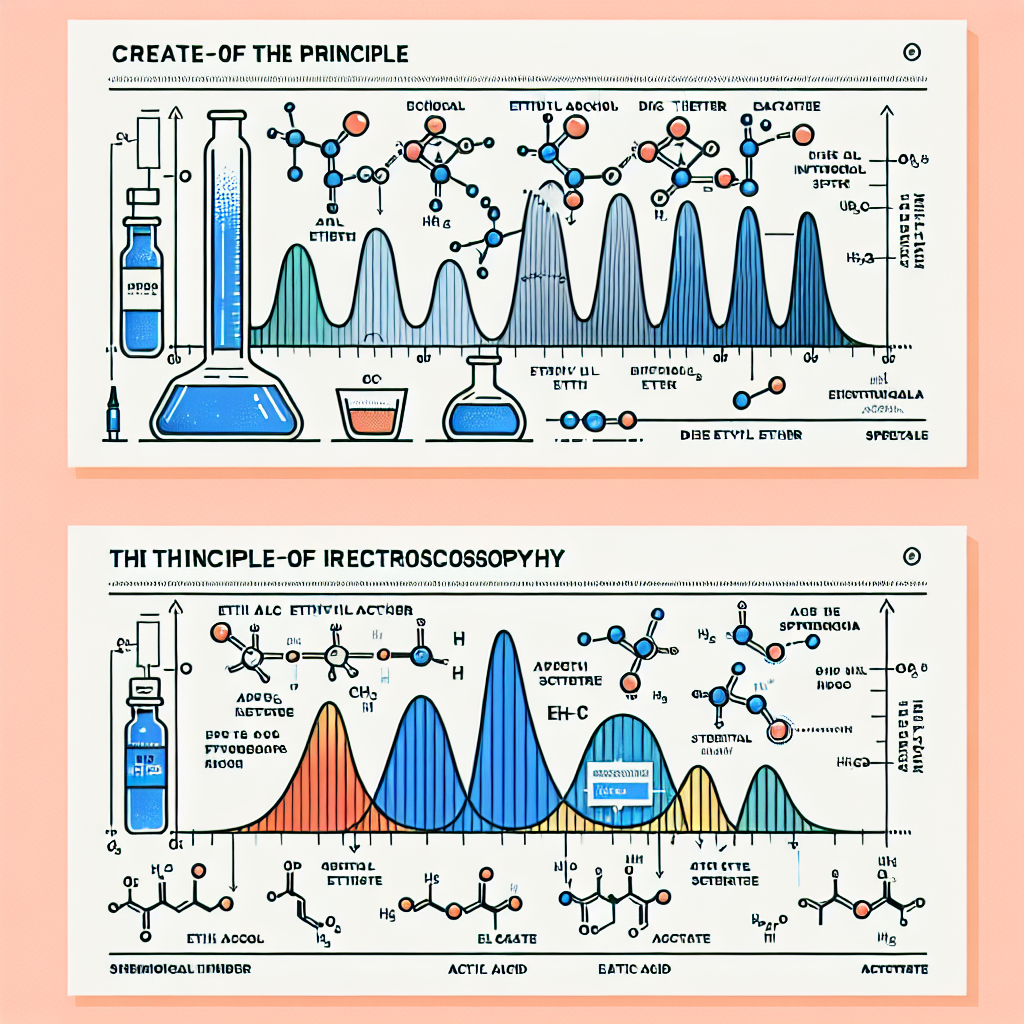
Discuss the principle of IR spectroscopy. How will you distinguish between the following pairs of compounds on the basis of IR spectroscopy:
(a) Ethyl alcohol and diethyl ether
(b) Acetic acid and ethyl acetate
The correct answer and explanation is :
Principle of IR Spectroscopy:
Infrared (IR) spectroscopy is an analytical technique used to identify and study chemicals based on how molecules absorb infrared light. When IR radiation passes through a compound, certain frequencies are absorbed by the molecule, causing specific bonds to vibrate (stretch, bend, or twist). These vibrations depend on the types of atoms involved and the nature of the chemical bonds. The resulting spectrum is a plot of absorption (or transmittance) versus frequency (usually in cm⁻¹), and each functional group shows characteristic absorption bands.
(a) Ethyl alcohol (CH₃CH₂OH) vs. Diethyl ether (CH₃CH₂OCH₂CH₃):
To distinguish between these compounds using IR spectroscopy:
- Ethyl alcohol:
- Shows a broad O–H stretching band around 3200–3600 cm⁻¹, due to hydrogen bonding.
- C–H stretching around 2900 cm⁻¹.
- C–O stretching around 1000–1100 cm⁻¹.
- Diethyl ether:
- Lacks an O–H group, so no broad O–H stretch.
- Shows C–H stretches (~2900 cm⁻¹).
- Shows C–O–C asymmetric and symmetric stretches in the 1050–1150 cm⁻¹ region.
👉 Key difference: Presence of broad O–H stretch in alcohol, absent in ether.
(b) Acetic acid (CH₃COOH) vs. Ethyl acetate (CH₃COOCH₂CH₃):
- Acetic acid:
- Broad O–H stretch around 2500–3300 cm⁻¹.
- Sharp C=O stretch of carboxylic acid near 1700–1725 cm⁻¹.
- O–H bending near 1400 cm⁻¹.
- Ethyl acetate:
- No O–H stretch (no carboxylic acid group).
- Shows C=O stretch of ester near 1735–1750 cm⁻¹.
- C–O stretches in the 1050–1300 cm⁻¹ range.
👉 Key difference: Broader O–H stretch and slightly lower C=O frequency in acetic acid vs. sharper, higher-frequency C=O in ester.
Summary:
IR spectroscopy distinguishes compounds by identifying functional groups. Alcohols and carboxylic acids show broad O–H stretches, while ethers and esters do not. Carbonyl stretching frequencies also help differentiate between acids and esters.