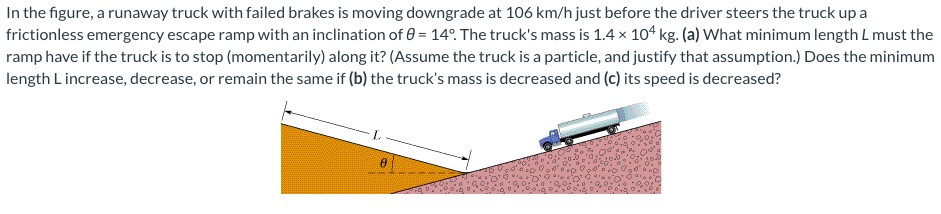
The Correct Answer And Eplanation is:
Given:
- Initial speed v0=106 km/h=29.44 m/sv_0 = 106 \, \text{km/h} = 29.44 \, \text{m/s}
- Inclination angle θ=14∘\theta = 14^\circ
- Mass of truck m=1.4×10⁴ kgm = 1.4 \times 10^4 \, \text{kg}
- Frictionless ramp
- The truck stops momentarily at the top of the ramp
(a) Minimum Length LL of the Ramp
We apply conservation of energy:
- Initial kinetic energy:
KE=12mv02KE = \frac{1}{2}mv_0^2 - Final potential energy at height hh:
PE=mghPE = mgh
Because the surface is frictionless and only conservative forces act, total energy is conserved: 12mv02=mgh\frac{1}{2}mv_0^2 = mgh
Canceling mass mm: 12v02=gh⇒h=v022g\frac{1}{2}v_0^2 = gh \Rightarrow h = \frac{v_0^2}{2g}
Now, relate height hh to ramp length LL using sinθ=hL\sin\theta = \frac{h}{L}: L=hsinθ=v022gsinθL = \frac{h}{\sin\theta} = \frac{v_0^2}{2g \sin\theta}
Plug in values:
- v0=29.44 m/sv_0 = 29.44 \, \text{m/s}
- g=9.8 m/s2g = 9.8 \, \text{m/s}^2
- θ=14∘\theta = 14^\circ
L=(29.44)22⋅9.8⋅sin(14∘)≈866.62⋅9.8⋅0.2419≈866.64.741≈182.8 mL = \frac{(29.44)^2}{2 \cdot 9.8 \cdot \sin(14^\circ)} \approx \frac{866.6}{2 \cdot 9.8 \cdot 0.2419} \approx \frac{866.6}{4.741} \approx 182.8 \, \text{m}
✅ Answer: Minimum Length ( L \approx 183 , \text{m}
(b) If Mass is Decreased
Since mass cancels out during energy conservation, the result does not depend on mass.
✅ Answer: Length LL remains the same.
(c) If Speed is Decreased
From the formula: L=v022gsinθL = \frac{v_0^2}{2g \sin\theta}
Lowering v0v_0 decreases v02v_0^2, which decreases LL.
✅ Answer: Length LL decreases.
Summary:
- (a) L≈183 mL \approx 183 \, \text{m}
- (b) Length remains the same if mass decreases.
- (c) Length decreases if speed decreases.