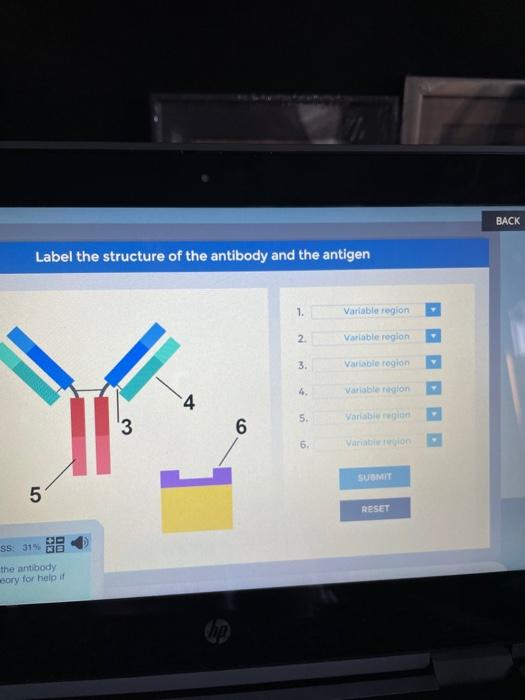
BACK Label the structure of the antibody and the antigen
Variable region
Variable region
Variable region
Variable region
Variable
Vanator
SUBMIT
RESET
ss: 1998 the antibody sory for help
The Correct Answer and Explanation is:
Based on the image you provided, this diagram illustrates the structure of an antibody and an antigen. Here’s the correct labeling for the numbered parts:
Correct Labels:
- Variable region (light chain)
- Variable region (heavy chain)
- Hinge region
- Constant region (light chain)
- Constant region (heavy chain)
- Antigen
Explanation
Antibodies, or immunoglobulins, are Y-shaped glycoproteins produced by B cells that identify and neutralize foreign substances like bacteria and viruses. Each antibody is composed of four polypeptide chains: two identical heavy chains and two identical light chains, connected by disulfide bonds.
The variable regions (labeled 1 and 2 in the diagram) are found at the tips of the Y-shaped molecule on both the light and heavy chains. These regions are highly specific to particular antigens and form the antigen-binding sites. The variation in amino acid sequence in these regions allows the immune system to recognize a vast array of antigens.
The hinge region (label 3) is a flexible segment of the antibody that connects the arms to the base. It allows the arms to move freely to better bind antigens spaced at different distances apart.
The constant region (labels 4 and 5) determines the class of the antibody (IgA, IgD, IgE, IgG, or IgM) and mediates the effector functions of the immune response. The constant region of the light chain (4) remains consistent within a given class of antibody. The heavy chain’s constant region (5) interacts with cell surface receptors and complement proteins to trigger immune responses like opsonization or cell lysis.
Lastly, label 6 represents the antigen, which is any molecule capable of triggering an immune response. The antibody binds specifically to a small portion of the antigen known as the epitope.
Understanding these structures is crucial in immunology, biotechnology, and medicine, particularly in the development of vaccines, monoclonal antibodies, and diagnostic tools.
