Classify these amino acids as acidic, basic, neutral polar, or neutral non polar.
The Correct Answer and Explanation is:
Correct Classification:
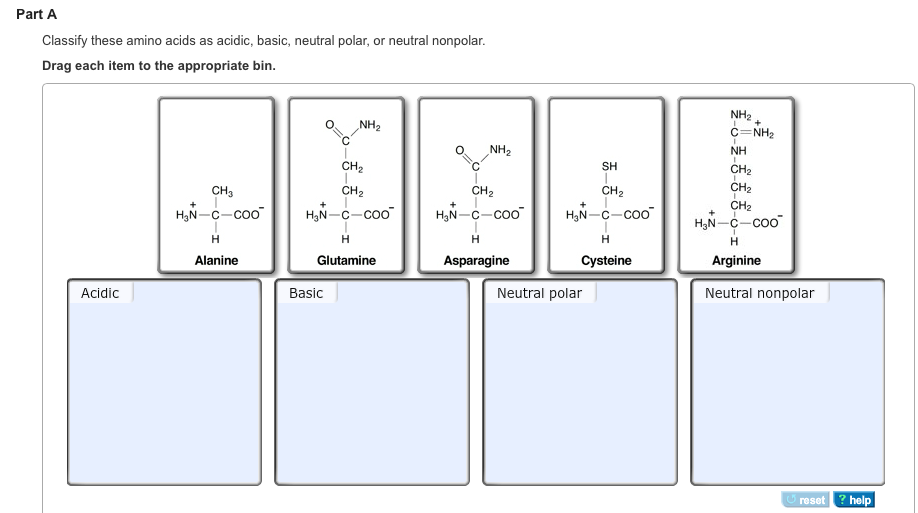
- Acidic: (None from this list)
- Basic: Arginine
- Neutral Polar: Glutamine, Asparagine, Cysteine
- Neutral Nonpolar: Alanine
Explanation
Amino acids can be classified based on the properties of their side chains (R-groups). These properties determine their chemical behavior, especially in aqueous solutions.
- Alanine: Its side chain is a simple methyl group (–CH₃), which is nonpolar and hydrophobic. It doesn’t form hydrogen bonds or participate in acid-base reactions. Thus, Alanine is classified as neutral nonpolar.
- Glutamine: It contains an amide group (–CONH₂) in its side chain, which can participate in hydrogen bonding due to its polarity. It is neither acidic nor basic under physiological conditions. Therefore, Glutamine is classified as neutral polar.
- Asparagine: Like glutamine, it has an amide group (–CONH₂) but with a shorter carbon chain. The amide side chain is polar but not charged at physiological pH. Hence, Asparagine is neutral polar.
- Cysteine: Contains a thiol (–SH) group, which is slightly polar and can form disulfide bonds (important in protein structure). It is not strongly acidic or basic but is polar due to the sulfur group. So, Cysteine is neutral polar.
- Arginine: Its side chain includes a guanidino group, which is positively charged at physiological pH due to resonance stabilization. This makes arginine strongly basic, as it readily accepts protons. Therefore, Arginine is classified as basic.
There are no acidic amino acids (like aspartic acid or glutamic acid) shown in this specific selection. Acidic amino acids would have a carboxyl group in their side chains that can donate protons.
Understanding these classifications helps in predicting amino acid behavior in proteins, especially concerning solubility, folding, and interactions with other molecules

.