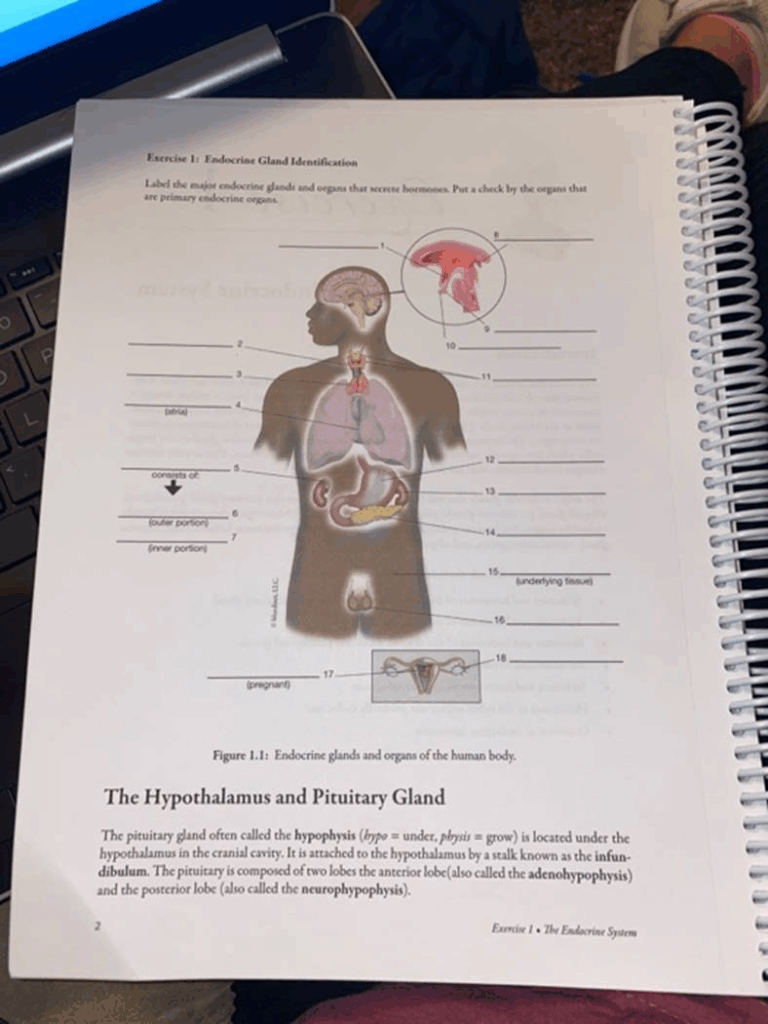
Exercise 1: Endocrine Gland Identification Label the major endocrine glands and organs that are hormones. Put a check by the organs that are primary endocrine or 10 consists of 13 Touter portion ne portion 15 underlying 18 pregnant Figure 1.1: Endocrine glands and organs of the human body. The Hypothalamus and Pituitary Gland The pituitary gland often called the hypophysis (hypo= under, pleysis grow) is located under the hypothalamus in the cranial cavity. It is attached to the hypothalamus by a stalk known as the infun- dibulum. The pituitary is composed of two lobes the anterior lobe(also called the adenohypophysis) and the posterior lobe (also called the neurophypophysis). 2 Exercise. The Endocrine System
The Correct Answer and Explanation is:
Correct Answers for Figure 1.1: Endocrine Glands and Organs of the Human Body
Here are the correctly labeled endocrine glands and organs:
- Hypothalamus ✔️
- Pituitary gland (hypophysis) ✔️
- Pineal gland ✔️
- Thyroid gland ✔️
- Parathyroid glands ✔️
- Thymus ✔️
- Heart
- Stomach
- Pancreas ✔️
- Adrenal glands ✔️
- Kidneys
- Small intestine
- Liver
- Ovaries (in females) ✔️
- Testes (in males) ✔️
- Placenta (in pregnant females) ✔️
- Uterus (pregnant)
- Uterus
Note: ✔️ indicates a primary endocrine organ, meaning it primarily secretes hormones.
Explanation
The endocrine system is a complex network of glands and organs that use hormones to regulate various functions in the body. Hormones act as chemical messengers, influencing metabolism, growth, reproduction, and homeostasis. In Figure 1.1, the primary endocrine glands are identified, and their roles are crucial in maintaining physiological balance.
The hypothalamus plays a central role by linking the nervous and endocrine systems. It controls the pituitary gland, often called the “master gland” because it regulates other endocrine glands. The pituitary is composed of two lobes: the anterior lobe (adenohypophysis), which releases hormones like growth hormone and prolactin, and the posterior lobe (neurohypophysis), which stores and releases oxytocin and antidiuretic hormone (ADH).
The pineal gland secretes melatonin, which regulates circadian rhythms. The thyroid gland produces hormones like thyroxine (T4) and triiodothyronine (T3), which influence metabolism. Adjacent to the thyroid are the parathyroid glands, which regulate calcium levels through parathyroid hormone (PTH).
The thymus is active in childhood and involved in T-cell maturation. The adrenal glands sit atop the kidneys and produce stress-related hormones like cortisol and adrenaline. The pancreas, a mixed gland, has endocrine functions through its islets of Langerhans, which secrete insulin and glucagon to control blood sugar.
In reproductive organs, ovaries and testes produce sex hormones such as estrogen, progesterone, and testosterone. During pregnancy, the placenta becomes a temporary endocrine gland, producing hormones to support fetal development.
Understanding these glands’ functions is critical for diagnosing and treating hormonal imbalances and endocrine disorders

.