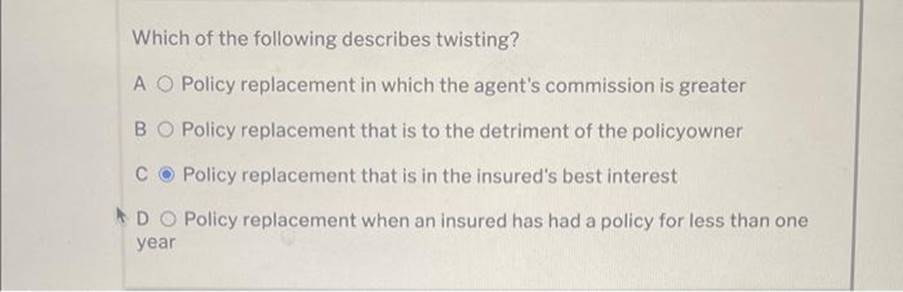
Which of the following describes twisting? A Policy replacement in which the agent’s commission is greater B Policy replacement that is to the detriment of the policyowner C Policy replacement that is in the insured’s best interest D Policy replacement when an insured has had a policy for less than one year
The Correct Answer and Explanation is:
The correct answer is:
B. Policy replacement that is to the detriment of the policyowner.
Explanation
Twisting is an unethical and often illegal practice in the insurance industry. It refers to the act of misrepresenting facts or using deceptive practices to persuade a policyholder to replace an existing insurance policy with a new one—typically to the benefit of the agent, but to the detriment of the policyholder.
Agents may engage in twisting to earn a higher commission, as new policies generally result in greater upfront payouts compared to renewals of existing policies. However, this replacement often causes the policyholder to lose accumulated benefits, face new waiting periods, or pay higher premiums without receiving improved coverage.
Key characteristics of twisting include:
- Deception or misrepresentation: The agent provides misleading information to encourage the replacement.
- Harm to the policyholder: The new policy offers no real benefit or may even be worse in terms of cost, benefits, or coverage.
- Agent benefit: The motivation is usually a higher commission or sales quota, not the best interest of the insured.
This practice is prohibited by insurance regulations in most jurisdictions. Regulatory bodies consider it a form of insurance fraud and impose penalties on agents or brokers found guilty of twisting.
Contrast this with churning, another unethical practice where the agent convinces a client to replace an existing policy with another from the same insurer, again for personal gain.
In the options provided:
- A may describe a motive for twisting, but doesn’t define it.
- C is the opposite of twisting—it describes an ethical replacement.
- D introduces a time frame not relevant to the definition.
Thus, Option B accurately captures the essence of twisting: a harmful replacement of a policy based on misleading advice or information.