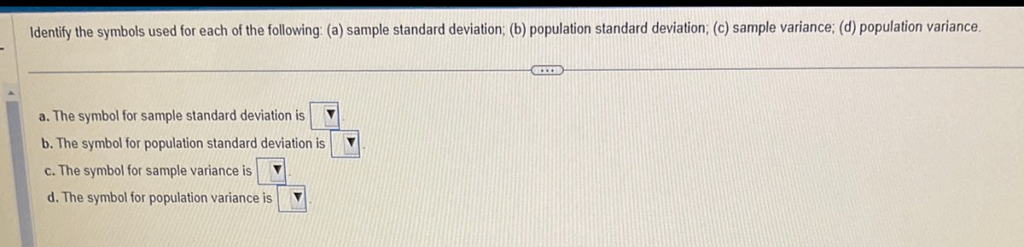
symbols used for each of the following: (a) sample standard deviation; (b) population standard deviation; (c) sample variance; (d) population variance. a. The symbol for sample standard deviation is b. The symbol for population standard deviation is c. The symbol for sample variance is d. The symbol for population variance is
The Correct Answer and Explanation is:
Here are the correct symbols for each of the statistical terms:
a. The symbol for sample standard deviation is: s
b. The symbol for population standard deviation is: σ (Greek letter sigma)
c. The symbol for sample variance is: s²
d. The symbol for population variance is: σ²
Explanation (Approx. 300 words):
Understanding the symbols used for standard deviation and variance is essential in statistics because these measures describe the spread or dispersion of data.
Standard deviation indicates how much individual data points deviate from the mean. It’s used to understand variability:
- For a sample, the standard deviation is represented by s. This is calculated when only a portion (sample) of the entire population is studied. The formula uses “n – 1” in the denominator to correct for bias in estimating the population standard deviation.
- For a population, the standard deviation is denoted by σ (sigma). This is used when the data set includes the entire population, and the formula uses “N” (the total number of data points).
Variance is the square of the standard deviation and gives a sense of data spread in squared units:
- Sample variance is denoted by s². Like the sample standard deviation, it also uses “n – 1” in its formula.
- Population variance is represented by σ². It is calculated by squaring the population standard deviation and uses “N” in the denominator.
In practice, knowing whether you’re dealing with a sample or an entire population is critical because the formulas and interpretations differ. Sample statistics (like s and s²) are used to estimate population parameters (like σ and σ²), and adjustments like Bessel’s correction (using n – 1) ensure more accurate estimation when working with limited data.
Correctly identifying and using these symbols is foundational for hypothesis testing, confidence intervals, and descriptive statistics. Misidentifying them can lead to significant errors in data analysis and decision-making.