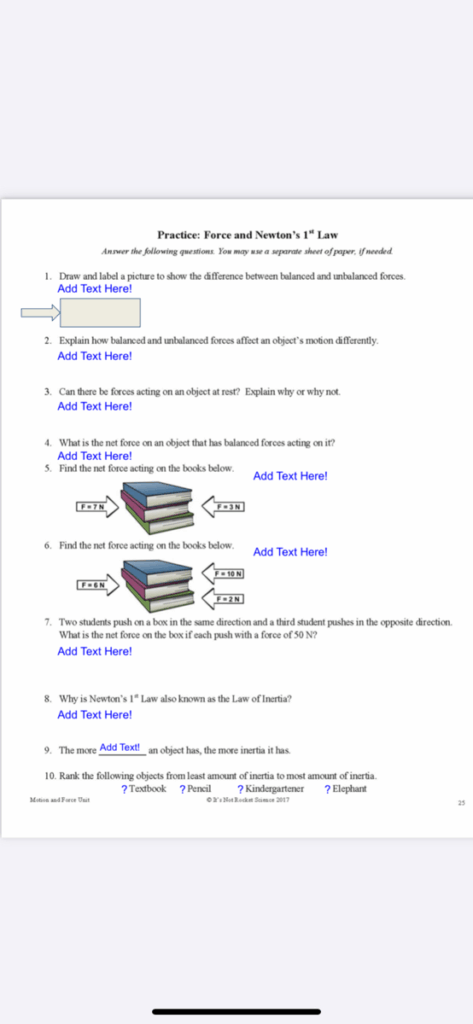
Draw and label a picture to show the difference between balanced and unbalanced forces. Add Text Here! 2. Explain how balanced and unbalanced forces affect an object’s motion differently. Add Text Here! 3. Can there be forces acting on an object at rest? Explain why or why not. Add Text Her
The Correct Answer and Explanation is:
1. Draw and Label a Picture to Show the Difference Between Balanced and Unbalanced Forces
While I can’t draw directly here, I’ll describe a simple diagram you can draw:
Balanced Forces Diagram
- Draw a box in the center.
- Draw two arrows of equal length pointing in opposite directions:
- Left arrow labeled 10 N ←
- Right arrow labeled → 10 N
- Label it “Balanced Forces – No Motion”
Unbalanced Forces Diagram
- Draw another box.
- Draw a left arrow labeled 5 N ←
- Draw a longer right arrow labeled → 15 N
- Indicate the direction of motion with a movement arrow pointing right.
- Label it “Unbalanced Forces – Motion Occurs”
2. Explain How Balanced and Unbalanced Forces Affect an Object’s Motion Differently
Balanced forces occur when the forces acting on an object are equal in size and opposite in direction. Because the net force is zero, the object remains at rest if it was already still, or continues moving at a constant speed if it was already in motion.
Unbalanced forces happen when the forces are not equal. This creates a net force that causes a change in the object’s motion—starting, stopping, speeding up, slowing down, or changing direction.
3. Can There Be Forces Acting on an Object at Rest? Explain Why or Why Not.
Yes, an object at rest can still have forces acting on it.
Explanation
When an object is at rest, it does not mean there are no forces acting on it; rather, it means the forces acting on it are balanced. For example, consider a book resting on a table. Gravity pulls the book downward with a force equal to its weight, and the table pushes upward with an equal and opposite normal force. These two forces cancel each other out, resulting in no net force and therefore no movement.
Another example is a person leaning against a wall. The person exerts a force on the wall, and the wall exerts an equal and opposite reaction force on the person. Again, the forces balance, so there’s no motion.
This balance of forces is a key concept in Newton’s First Law of Motion, which states that an object will remain at rest or in uniform motion unless acted upon by an unbalanced force. So, as long as the forces are balanced, the object remains still or moves at a constant velocity.
In summary, objects at rest can and often do have multiple forces acting on them. However, if these forces are balanced (equal in size and opposite in direction), their effects cancel out, and the object remains motionless. This is a fundamental concept in understanding how forces interact to affect motion, and it helps explain why not all forces cause movement immediately—only unbalanced forces change the state of motion.
