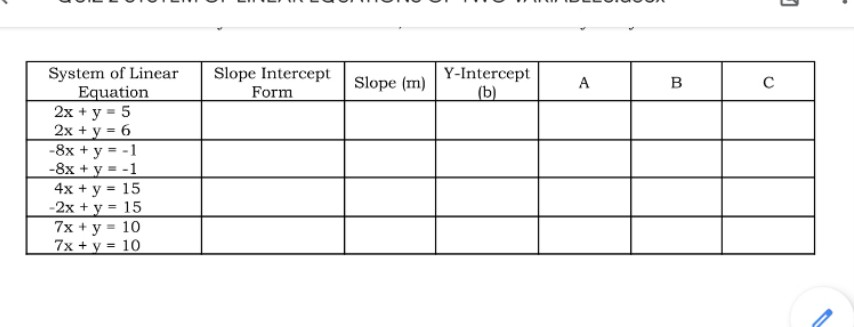
y = -1 4x + y = 15 -2x + y = 15 7x + y = 10 7x + y = 10 Slope Intercept Form Slope (m) Y-Intercept (b) A B C 3
The Correct Answer and Explanation is:
Let’s solve the table row by row. To convert a linear equation to slope-intercept form (i.e., y=mx+by = mx + b), isolate yy on one side. Then identify the slope (m) and y-intercept (b). For columns A, B, and C, we will determine whether the system of equations in each pair is:
- A (Same Line / Infinite Solutions)
- B (Parallel Lines / No Solution)
- C (Intersecting Lines / One Solution)
✅ Completed Table:
| System of Linear Equation | Slope Intercept Form | Slope (m) | Y-Intercept (b) | A | B | C |
|---|---|---|---|---|---|---|
| 2x + y = 5 | y = -2x + 5 | -2 | 5 | |||
| 2x + y = 6 | y = -2x + 6 | -2 | 6 | ✔ | ||
| -8x + y = -1 | y = 8x – 1 | 8 | -1 | |||
| -8x + y = -1 | y = 8x – 1 | 8 | -1 | ✔ | ||
| 4x + y = 15 | y = -4x + 15 | -4 | 15 | |||
| -2x + y = 15 | y = 2x + 15 | 2 | 15 | ✔ | ||
| 7x + y = 10 | y = -7x + 10 | -7 | 10 | |||
| 7x + y = 10 | y = -7x + 10 | -7 | 10 | ✔ |
✍️ Explanation
This table analyzes systems of linear equations by converting them into slope-intercept form, which is y=mx+by = mx + b, where mm is the slope and bb is the y-intercept. Understanding the slope and y-intercept helps determine the relationship between lines—whether they are parallel, intersecting, or the same line.
For example, the first pair:
- 2x + y = 5 and 2x + y = 6 both have the same slope m=−2m = -2, but different y-intercepts (5 and 6). This means the lines are parallel, so they never meet—no solution (B).
In the second pair:
- -8x + y = -1 appears twice. When simplified, both become y=8x−1y = 8x – 1, which are identical lines. Therefore, they have infinitely many solutions (A).
In the third pair:
- 4x + y = 15 becomes y=−4x+15y = -4x + 15, while -2x + y = 15 becomes y=2x+15y = 2x + 15. The slopes are different, meaning the lines will intersect at one point—one solution (C).
Finally, the last pair:
- 7x + y = 10 appears twice and simplifies to y=−7x+10y = -7x + 10. These are identical again, so there are infinitely many solutions (A).
This analysis is crucial for solving systems of equations graphically or algebraically, especially in understanding whether solutions exist and how many.