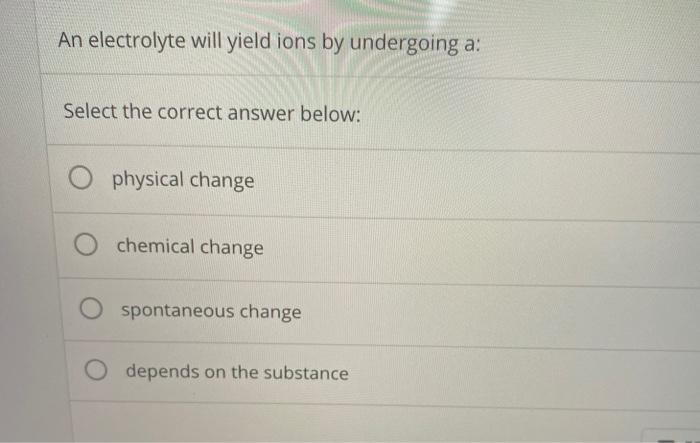
An electrolyte will yield ions by undergoing a:
Select the correct answer below:
physical change
chemical change
spontaneous change
depends on the substance
The Correct Answer and Explanation is:
Correct Answer: physical change
Explanation:
An electrolyte is a substance that produces ions when it dissolves in water, making the solution capable of conducting electricity. This process is primarily a physical change, not a chemical change. Here’s why:
When an electrolyte such as NaCl (table salt) dissolves in water, it dissociates into its constituent ions — Na⁺ and Cl⁻. This dissociation happens without altering the chemical structure of the ions themselves; no new substances are formed. The process is reversible, meaning if the water is evaporated, NaCl can recrystallize — a hallmark of a physical change.
There are two main types of electrolytes:
- Strong electrolytes (e.g., NaCl, HCl): These dissociate completely into ions in water.
- Weak electrolytes (e.g., acetic acid): These dissociate only partially.
Even when a weak acid like acetic acid undergoes partial ionization, the process is still a physical change because the molecular identity of acetic acid is maintained, and it exists in equilibrium with its ions.
In contrast, a chemical change involves the formation or breaking of chemical bonds and results in the creation of new substances with different chemical properties. For example, rusting of iron or combustion of gasoline are chemical changes — neither of which occurs when an electrolyte simply dissolves and ionizes in water.
Therefore, the correct answer is “physical change”, as dissolving and ionizing into ions involves no permanent chemical transformation, just a change of state and dispersion of particles.
Note: While some electrolytes (e.g., acids and bases) might participate in chemical reactions later, the act of becoming an electrolyte (i.e., forming ions in solution) is itself a physical process.