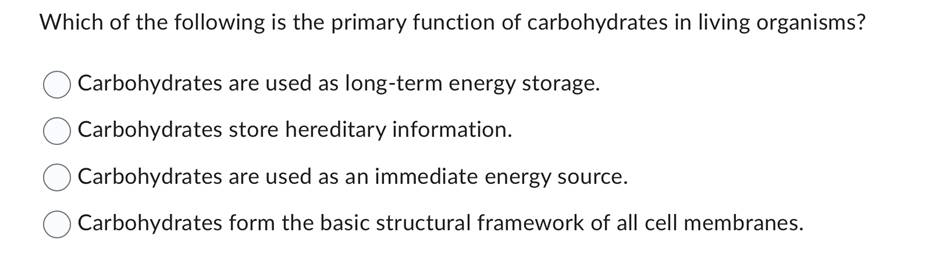
Which of the following is the primary function of carbohydrates in living organisms?
Carbohydrates are used as long-term energy storage.
Carbohydrates store hereditary information.
Carbohydrates are used as an immediate energy source.
Carbohydrates form the basic structural framework of all cell membranes.
The Correct Answer and Explanation is:
Correct Answer: Carbohydrates are used as an immediate energy source.
Explanation
Carbohydrates play a vital role in the metabolism of living organisms, primarily serving as a quick and efficient source of energy. They are organic molecules composed of carbon, hydrogen, and oxygen, and are found in forms such as sugars, starches, and fibers. Among their various functions, the most crucial and immediate is their role in providing energy to cells.
When carbohydrates are consumed, they are broken down into simpler sugars, mainly glucose, during the digestive process. Glucose is then transported through the bloodstream to cells, where it undergoes cellular respiration—a process that generates adenosine triphosphate (ATP), the energy currency of the cell. ATP is used to power essential cellular activities like muscle contraction, nerve impulse transmission, and biosynthesis of macromolecules.
Unlike lipids, which are used for long-term energy storage, carbohydrates are metabolized quickly, making them ideal for immediate energy needs. This is why athletes often consume carbohydrate-rich foods before and after intense physical activity—they provide rapid fuel for the body.
The other options listed do not reflect the primary function of carbohydrates:
- Long-term energy storage is primarily the role of lipids (fats), not carbohydrates.
- Hereditary information is stored in nucleic acids (DNA and RNA), not carbohydrates.
- While carbohydrates may play some structural roles (e.g., cellulose in plant cell walls), they do not form the structural framework of all cell membranes—this is mainly the function of phospholipids and proteins.
In summary, carbohydrates are crucial for sustaining life because they offer a readily accessible and efficient source of energy needed for the proper functioning of cells and organs in living organisms.