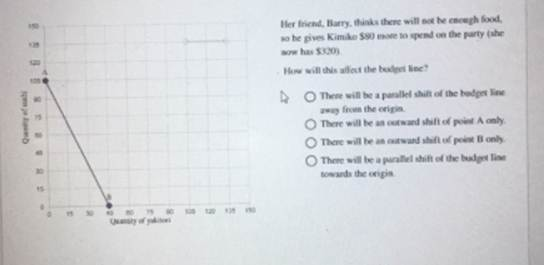
Kimiko is planning a party to celebrate her birthday. She has decided to serve sushi and yakitori meat skewers. Each serving of sushi is $8 and each yakitori skewer is $2. Kimiko has $240 to spend on the party. Please graph her budget line.
The Correct Answer and Explanation is:
Correct Answer:
✅ There will be a parallel shift of the budget line away from the origin.
Explanation:
Kimiko initially has $240 to spend on sushi and yakitori. Sushi costs $8 per serving and yakitori costs $2 per skewer. The budget line represents all combinations of sushi and yakitori she can afford with her budget.
The budget line equation is: 8S+2Y=2408S + 2Y = 240
Where:
- SS is the number of sushi servings
- YY is the number of yakitori skewers
To graph this line:
- If Kimiko buys only yakitori: 2Y=240⇒Y=1202Y = 240 \Rightarrow Y = 120
- If Kimiko buys only sushi: 8S=240⇒S=308S = 240 \Rightarrow S = 30
So, the budget line goes from point (0, 120) (all yakitori) to (30, 0) (all sushi). This is shown in the image.
Now, Barry gives Kimiko $60 more, raising her total budget to $300. The new budget equation becomes: 8S+2Y=3008S + 2Y = 300
Solving this:
- Only yakitori: Y=150Y = 150
- Only sushi: S=37.5S = 37.5
So the entire budget line shifts outward—specifically, it shifts parallel away from the origin because the prices of sushi and yakitori remain the same. The slope of the line (which depends on the relative prices of the two goods) does not change, so the line remains parallel to the original.
This is a classic example of an income increase with constant prices. In such cases, the budget constraint expands outward in a parallel fashion, allowing the consumer (Kimiko) to afford more of both goods if desired.
Therefore, the correct choice is:
✅ There will be a parallel shift of the budget line away from the origin.