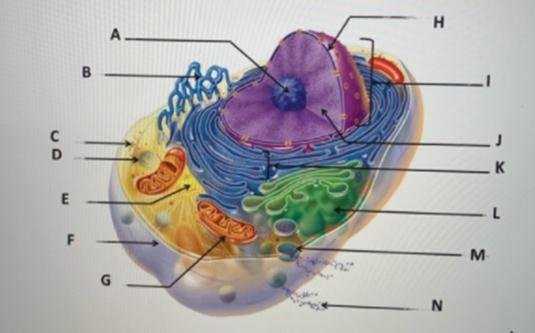
Label the parts of the cells. Each label is worth one point. nucleus 13 vacuole 1. A nuclear envelope B nucleus 13 vacuole nuclear envelope mitochondrion smooth endoplasmic reticulum ribosomes rough endoplasmic reticulum plasma membrane Lysosome proteins 10. Golgi complex chromatin rough endoplasmic reticulum 7. G 8. H plasma membrane – 9. Lysosome 10. J – proteins 11. K Golgi complex 12. L – chromatin 13. M. 3 Centrioles 14. N z nucleolus Question 10 (2 points) Movement of molecules and ions that result from their kinetic energy and go regions of high to low concentration is called
The Correct Answer and Explanation is:
Here are the correctly labeled parts of the cell diagram based on the labels provided:
A. Nuclear envelope
B. Rough endoplasmic reticulum
C. Ribosomes
D. Mitochondrion
E. Smooth endoplasmic reticulum
F. Vacuole
G. Plasma membrane
H. Nucleolus
I. Chromatin
J. Proteins
K. Golgi complex
L. Rough endoplasmic reticulum
M. Centrioles
N. Lysosome
Question 10: Movement of molecules from high to low concentration
Answer: Diffusion
Explanation
Diffusion is the passive movement of molecules or ions from a region of higher concentration to a region of lower concentration. This process is driven by the molecules’ inherent kinetic energy and does not require cellular energy input (ATP). Diffusion is a fundamental principle of biology and plays a vital role in the transport of substances across cell membranes and within cells.
In a biological context, diffusion helps maintain homeostasis by regulating the internal environment of the cell. For instance, oxygen diffuses from areas of high concentration (like the bloodstream) into cells where its concentration is lower. Similarly, carbon dioxide, a waste product of cellular respiration, diffuses out of cells into the blood to be expelled from the body.
Diffusion can occur through the phospholipid bilayer of the cell membrane (simple diffusion) or with the help of protein channels and carriers (facilitated diffusion). In both cases, the direction of movement is determined by the concentration gradient. The steeper the gradient, the faster the rate of diffusion.
Key factors affecting the rate of diffusion include temperature, concentration gradient, surface area of the membrane, and the size and nature of the molecules. Small, nonpolar molecules like O₂ and CO₂ diffuse easily through cell membranes, while larger or charged molecules require protein assistance.
Diffusion is crucial in many physiological processes, such as gas exchange in the lungs, nutrient absorption in the intestines, and the removal of metabolic waste. It is also the basis of several laboratory techniques and industrial applications.
Overall, diffusion represents a vital, energy-efficient mechanism by which cells and organisms maintain the proper balance of ions, gases, and other small molecules necessary for life.