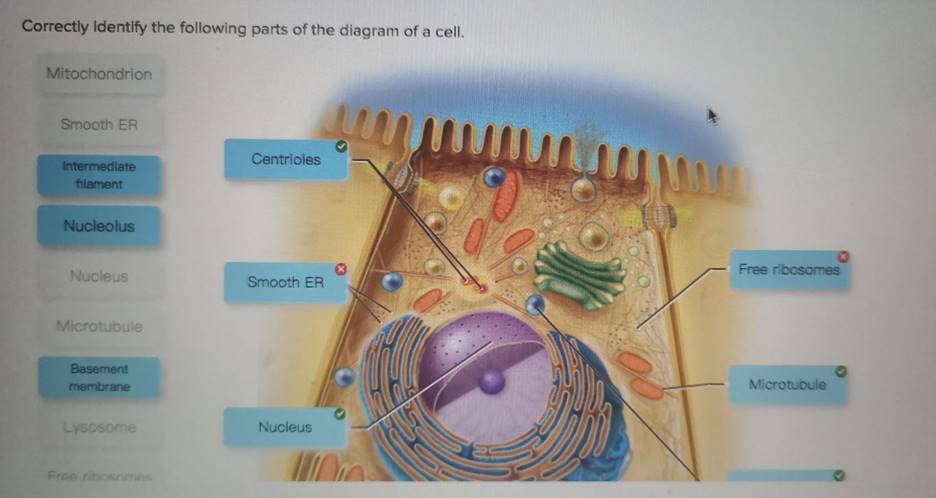
Correctly identify the following parts of the diagram of a cell. Mitochondrion Smooth ER Centrioles Intermediate filament Nucleolus Nucleus Free ribosomes Smooth ER Microtubule Basement membrane Microtubule Lysosome Nucleus Free ribosomes
label the two wrong parts of the diagram of a cell
The Correct Answer and Explanation is:
In the provided image of a cell diagram, two parts are incorrectly labeled:
❌ Incorrect Label 1: “Smooth ER”
- Actual Structure: Rough Endoplasmic Reticulum (Rough ER)
- Explanation: The structure labeled “Smooth ER” is covered in small dots, which are ribosomes. These ribosomes give the ER a “rough” appearance, distinguishing it from the Smooth ER, which lacks ribosomes. Rough ER is responsible for the synthesis of membrane-bound and secretory proteins, while the Smooth ER is involved in lipid synthesis and detoxification.
❌ Incorrect Label 2: “Free Ribosomes”
- Actual Structure: Golgi Apparatus
- Explanation: The labeled structure resembles a stack of flattened, membrane-bound sacs typical of the Golgi apparatus, not free-floating ribosomes. The Golgi apparatus modifies, sorts, and packages proteins and lipids for secretion or for use within the cell. Free ribosomes, on the other hand, are small, spherical structures that float freely in the cytoplasm and synthesize proteins for use within the cell.
🧬 Detailed Explanation
A typical eukaryotic cell contains various organelles, each with specific functions critical for cell survival and operation. Correct identification of these organelles is essential in understanding cellular biology.
In the image, the Rough ER is misidentified as Smooth ER. The presence of ribosomes on its surface is a defining feature of the Rough ER, which plays a key role in protein synthesis—especially for proteins destined for secretion or for use in lysosomes or membranes. The Smooth ER, by contrast, lacks these ribosomes and is typically involved in lipid metabolism, calcium storage, and detoxification processes.
The second misidentification is the Golgi apparatus being labeled as Free ribosomes. Free ribosomes are individual, small granules found floating in the cytoplasm and are involved in synthesizing proteins that remain in the cell’s cytosol. The Golgi apparatus, however, consists of a series of stacked, membrane-bound sacs and is essential for processing and shipping proteins and lipids produced by the ER. It receives proteins in vesicles, modifies them (e.g., glycosylation), and sends them to their final destinations.
Understanding the structure-function relationships of organelles like the ER and Golgi apparatus is vital in fields like molecular biology and medicine, where disruptions in these systems can lead to diseases such as cystic fibrosis, Alzheimer’s, and certain types of cancer.