Suppose that a very simple economy produces only four
goods and services: eye examinations, pizzas, shoes, and
cheese. Assume that all the cheese in this economy is used
in the production of pizzas. Use the information in the following
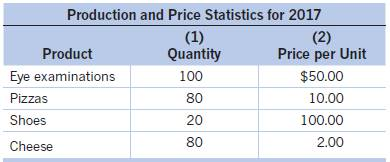
table to compute GDP for the year 2017.
The Correct Answer and Explanation is:
To compute GDP for the year 2017 in this simple economy, we need to follow the expenditure approach to GDP, which values only final goods and services to avoid double counting.
Step-by-Step GDP Calculation:
From the table:
| Product | Quantity | Price per Unit | Total Value (Price × Quantity) |
|---|---|---|---|
| Eye examinations | 100 | $50.00 | $5,000 |
| Pizzas | 80 | $10.00 | $800 |
| Shoes | 20 | $100.00 | $2,000 |
| Cheese | 80 | $2.00 | $160 (Intermediate Good) |
Important Note: Cheese is not counted in GDP because it is an intermediate good, used in the production of pizzas (a final good). Including cheese would lead to double counting since its value is already embedded in the value of pizzas.
Total GDP =
- Eye examinations: $5,000
- Pizzas: $800
- Shoes: $2,000
- Cheese: $0 (intermediate)
Total GDP = $5,000 + $800 + $2,000 = $7,800
Explanation:
Gross Domestic Product (GDP) is a measure of the total market value of all final goods and services produced within a country in a specific period, usually one year. The purpose of GDP is to capture the economic output that reflects actual consumption and investment without inflating the figure by including intermediate goods used in production.
In this simple economy, there are four products: eye examinations, pizzas, shoes, and cheese. To calculate GDP, we must consider only the final goods—those purchased for final use—and exclude intermediate goods—those used in the production of other goods.
In this case, cheese is identified as an intermediate good because it is entirely used to make pizzas. Therefore, even though cheese has a market value ($160), it should not be included in GDP directly. Its value is already reflected in the price of pizzas, which are sold as final products to consumers.
Using the expenditure approach, we multiply the quantity of each final product by its price to determine the total market value. Eye examinations and shoes are services and durable goods consumed by individuals, and pizzas are a final food product. When we calculate the total value of these three categories—$5,000 (eye exams) + $800 (pizzas) + $2,000 (shoes)—we arrive at a GDP of $7,800.
This method ensures accurate economic measurement without overestimating output, which is crucial for policymakers, businesses, and economists who rely on GDP to assess economic health and guide decision-making.