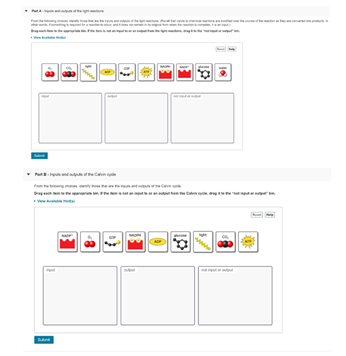
Part A-inputs and outputs of the light reactions? From the following choices, identify those that are the inputs and outputs of the light reactions. Part A-inputs and outputs of the light reactions? From the following choices, identify those that are the inputs and outputs of the light reactions. (Recall that inputs to chemical reactions are modified over the course of the reaction as they are converted into products. In other words, if something is required for a reaction to occur, and it does not remain in its original form when the reaction is complete, it is an input.) Drag each item to the appropriate bin. If the item is not an input to or an output from the light reactions, drag it to the not input or output bin. View Available Hint(s) Roset Help NADP ADP ATP input output not input or output Submit Part B Inputs and outputs of the Calvin cycle From the following choices, identify those that are the inputs and outputs of the Calvin cycle. Drag each item to the appropriate bin. If the item is not an input to or an output from the Calvin cycle, drag it to the not input or output bin. View Available Hint(s) Reset Help NADP NADPH light O2 G3P ADP ATP input output not input or output Submit
The Correct Answer and Explanation is:
Correct Sorting:
Part A – Inputs and Outputs of the Light Reactions
- Inputs:
- H₂O (water)
- Light
- NADP⁺
- ADP
- Outputs:
- O₂ (oxygen)
- ATP
- NADPH
- Not input or output:
- CO₂
- G3P (Glyceraldehyde-3-phosphate)
Part B – Inputs and Outputs of the Calvin Cycle
- Inputs:
- CO₂
- ATP
- NADPH
- Outputs:
- G3P
- Not input or output:
- O₂
- Light
- NADP⁺
- ADP
Explanation
Photosynthesis in plants occurs in two major stages: the light reactions and the Calvin cycle, each with distinct inputs and outputs.
Part A – Light Reactions:
These reactions occur in the thylakoid membranes of the chloroplasts and require light energy, water (H₂O), NADP⁺, and ADP. Light energy is captured by chlorophyll and used to split water molecules, releasing oxygen (O₂) as a byproduct. The electrons from water move through the electron transport chain, converting NADP⁺ to NADPH and ADP to ATP—both of which are energy carriers required in the next stage, the Calvin cycle.
Part B – Calvin Cycle:
This cycle occurs in the stroma of the chloroplast and does not require light directly. It uses the ATP and NADPH produced by the light reactions to fix carbon dioxide (CO₂) into organic molecules. The main product is G3P (glyceraldehyde-3-phosphate), a three-carbon sugar that can be used to form glucose and other carbohydrates. The Calvin cycle regenerates ADP and NADP⁺, which return to the light reactions for reuse.
Some items are not directly involved in certain stages. For example, oxygen is not involved in the Calvin cycle, and CO₂ is not part of the light reactions. Similarly, light is unnecessary for the Calvin cycle but essential for the light reactions.
Understanding these distinctions clarifies the overall photosynthetic process, highlighting how the two stages are interconnected through their energy and electron carriers.