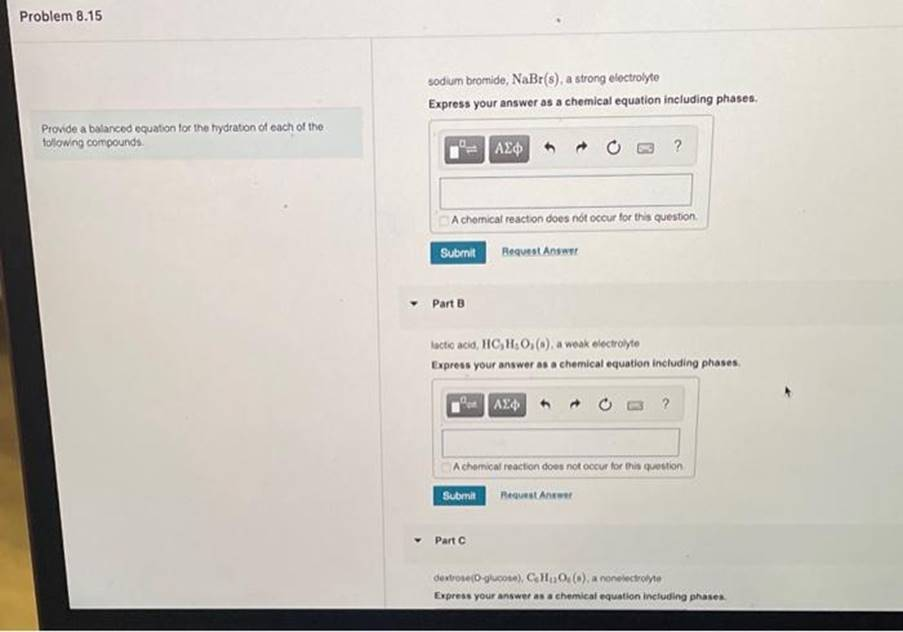
sodium bromide, NaBr(s), a strong electrolyte Express your answer as a chemical equation including phases. Provide a balanced equation for the tydration of each of the tollowing compounds. Part B lactio acid, HC
3
?
H
5
?
O(O (a), a weak electrolyte Express your answer as a chemical equation including phases. A chomical reaction does not occur for this quevian – Partc Express yout answet as a chemical
The Correct Answer and Explanation is:
Part A: Sodium bromide, NaBr(s), a strong electrolyte
Balanced equation: NaBr(s)→H2ONa+(aq)+Br−(aq)\text{NaBr}(s) \xrightarrow{H_2O} \text{Na}^+(aq) + \text{Br}^-(aq)
Explanation:
Sodium bromide is a strong electrolyte, which means it completely dissociates into its constituent ions when dissolved in water. When solid NaBr is added to water, it dissociates into sodium ions (Na⁺) and bromide ions (Br⁻). These ions become surrounded by water molecules in a process known as hydration. The (aq) symbol indicates that the ions are in aqueous solution, i.e., surrounded by water molecules. No molecular NaBr remains in solution.
Part B: Lactic acid, HC₃H₅O₃(aq), a weak electrolyte
Balanced equation: HC3H5O3(aq)⇌H+(aq)+C3H5O3−(aq)\text{HC}_3\text{H}_5\text{O}_3(aq) \rightleftharpoons \text{H}^+(aq) + \text{C}_3\text{H}_5\text{O}_3^-(aq)
Explanation:
Lactic acid is a weak electrolyte, meaning it only partially ionizes in water. When lactic acid dissolves, only some molecules donate a proton (H⁺), forming lactate ions (C₃H₅O₃⁻). The majority of the lactic acid remains as intact molecules. The equilibrium arrow (⇌) shows that this is a reversible reaction and does not go to completion. This partial ionization is typical of weak acids in aqueous solution.
Part C: Dextrose (D-glucose), C₆H₁₂O₆(s), a nonelectrolyte
Balanced equation: C6H12O6(s)→H2OC6H12O6(aq)\text{C}_6\text{H}_{12}\text{O}_6(s) \xrightarrow{H_2O} \text{C}_6\text{H}_{12}\text{O}_6(aq)
Explanation:
Dextrose (glucose) is a nonelectrolyte, which means it does not dissociate into ions in water. When dextrose dissolves, the solid C₆H₁₂O₆ simply disperses into individual molecules that are surrounded by water molecules (hydrated), but no ions are formed. Thus, the formula remains the same before and after dissolution—just the phase changes from solid to aqueous. No chemical reaction occurs.
Summary (Key Points for Understanding):
- Strong electrolytes dissociate completely (e.g., NaBr).
- Weak electrolytes dissociate partially and reach equilibrium (e.g., lactic acid).
- Nonelectrolytes dissolve without ionizing (e.g., glucose).
- Hydration refers to the process of water molecules surrounding ions or molecules in solution.
- These hydration equations are essential for understanding electrical conductivity in solutions and acid/base behavior.