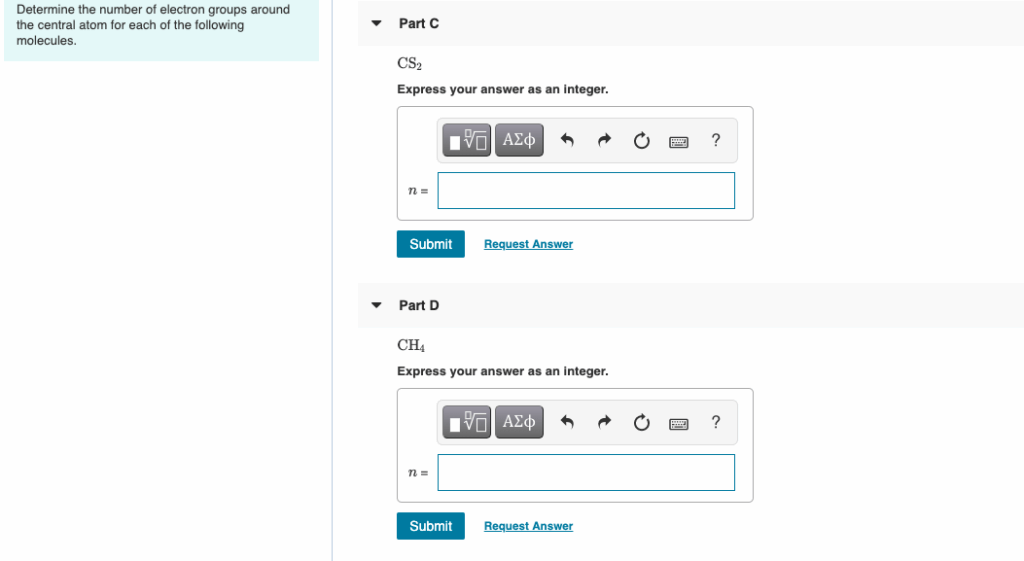
 Determine the number of electron groups around the central atom for each of the following molecules. Part C CS₂ Express your answer as an integer. n = Submit Part D [ΫΠΑΣΦ n = CH4 Express your answer as an integer. Request Answer IVE ΑΣΦ Submit Request Answer ? ?
The Correct Answer and Explanation is:
Correct Answers:
- Part C (CS₂): n = 2
- Part D (CH₄): n = 4
Explanation:
In chemistry, electron groups around the central atom refer to regions where electrons are found — either as bonding pairs (single, double, or triple bonds all count as one electron group each) or as lone (non-bonding) pairs. The concept is essential for predicting molecular geometry using VSEPR theory (Valence Shell Electron Pair Repulsion theory).
Part C: CS₂ (Carbon Disulfide)
Lewis Structure:
- The central atom is carbon.
- Each sulfur atom forms a double bond with the central carbon, giving a structure of S=C=S.
- Carbon has no lone pairs.
Electron Group Count:
- Each double bond (C=S) counts as one electron group.
- Total: 2 double bonds → 2 electron groups.
Molecular Geometry:
- With 2 electron groups, the shape is linear.
- Bond angle: approximately 180°.
Summary:
- Electron groups: 2
- Reason: Two double bonds from carbon to sulfur, each counted as one group.
Part D: CH₄ (Methane)
Lewis Structure:
- The central atom is carbon.
- It forms four single bonds with four hydrogen atoms.
- Carbon has no lone pairs.
Electron Group Count:
- Each single bond counts as one electron group.
- Total: 4 single bonds → 4 electron groups.
Molecular Geometry:
- With 4 electron groups, the shape is tetrahedral.
- Bond angle: approximately 109.5°.
Summary:
- Electron groups: 4
- Reason: Four bonding pairs (single bonds) around the central carbon atom.
Conclusion:
Understanding electron group counts helps in predicting molecular shape, bond angles, and polarity — all fundamental concepts in molecular geometry and bonding theory

.