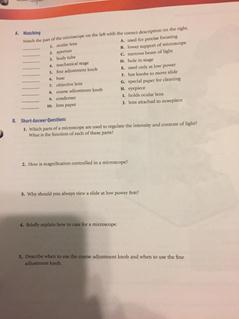
Match the part of the microscope on the left with the correct description on the right Description: A. Matching Match the part of the microscope on the left with the correct description on the right. 1. ocular lens 2. aperture 3. body tube 4. mechanical stage 5. fine adjustment knob 6. base 7. objective lens 8. coarse adjustment knob 9. condenser 10. lens paper A. used for precise focusing B. lower support of microscope C. narrows beam of light D. hole in stage E. used only at low power F. has knobs to move slide G. special paper for cleaning H. eyepiece holds ocular lens I. lens attached to nosepiece Short-Answer Questions 1. Which parts of a microscope are used to regulate the intensity and contrast of light? What is the function of each of these parts? 2. How is magnification controlled in a microscope? 3. Why should you always view a slide at low power first? 4. Briefly explain how to care for a microscope. 5. Describe when to use the coarse adjustment knob and when to use the fine adjustment knob.
The Correct Answer and Explanation is:1
Here is the completed worksheet with correct answers for the matching section and short-answer questions, followed by a 300-word explanation:
A. Matching
| Part of Microscope | Matching Description |
|---|---|
| 1. ocular lens | H. eyepiece holds ocular lens |
| 2. aperture | D. hole in stage |
| 3. body tube | A. used for precise focusing |
| 4. mechanical stage | F. has knobs to move slide |
| 5. fine adjustment knob | A. used for precise focusing |
| 6. base | B. lower support of microscope |
| 7. objective lens | I. lens attached to nosepiece |
| 8. coarse adjustment knob | E. used only at low power |
| 9. condenser | C. narrows beam of light |
| 10. lens paper | G. special paper for cleaning |
B. Short-Answer Questions
- Parts that regulate intensity and contrast:
- Diaphragm/aperture: Controls the amount of light that passes through the specimen.
- Condenser: Focuses the light onto the specimen, improving contrast and clarity.
- Light intensity knob (on light source): Regulates the brightness of the light.
- Magnification is controlled by combining the power of the ocular lens (usually 10x) with the objective lens (e.g., 4x, 10x, 40x). Total magnification = ocular × objective.
- You should start with low power to:
- Easily locate the specimen,
- Prevent damaging the slide or lens,
- Get a broader view of the sample.
- To care for a microscope:
- Always carry it with both hands (arm and base),
- Use lens paper to clean lenses,
- Cover it when not in use,
- Store in a dry place,
- Avoid using coarse focus on high power.
- Use the coarse adjustment knob on low power only to bring the specimen roughly into focus. Use the fine adjustment knob at medium and high power for sharp, precise focusing.
Explanation
Microscopes are essential tools in science for magnifying small specimens. Understanding their parts and proper use ensures accuracy and safety. The ocular lens (eyepiece) and objective lenses work together to control magnification. Most microscopes provide total magnification by multiplying the power of the ocular lens (usually 10x) with that of the selected objective lens (e.g., 4x, 10x, or 40x).
Light regulation is crucial for clear viewing. The aperture controls the diameter of the light beam passing through the specimen, affecting brightness and contrast. The condenser focuses light directly onto the specimen, while the light intensity control (if available) adjusts brightness. Using these together helps achieve the ideal contrast and resolution for viewing.
Starting with low power is important to avoid damaging the slides or lenses and to help locate the specimen easily. The coarse adjustment knob should only be used under low power because it moves the stage significantly and can crash the lens into the slide. The fine adjustment knob is used for precise focusing and is safe to use at all powers, especially high magnifications.
Caring for a microscope extends its lifespan and ensures reliable performance. Always handle it gently, clean lenses with proper lens paper, and store it safely. Improper use can lead to scratches on lenses or mechanical failure.
By understanding how to operate and maintain a microscope, users can observe specimens effectively, gaining clearer insights into microscopic worlds. Proper technique ensures both the safety of the equipment and the accuracy of the observations.