: The Urinary System t-Labeling Activity: A generalized nephron and collecting system Drag the appropriate labels to their respective targets. Reset Help Renal cortex Distal tubule Nephron loop Renal corpuscle Renal medulla Collecting duct Proximal tubule
The Correct Answer and Explanation is:
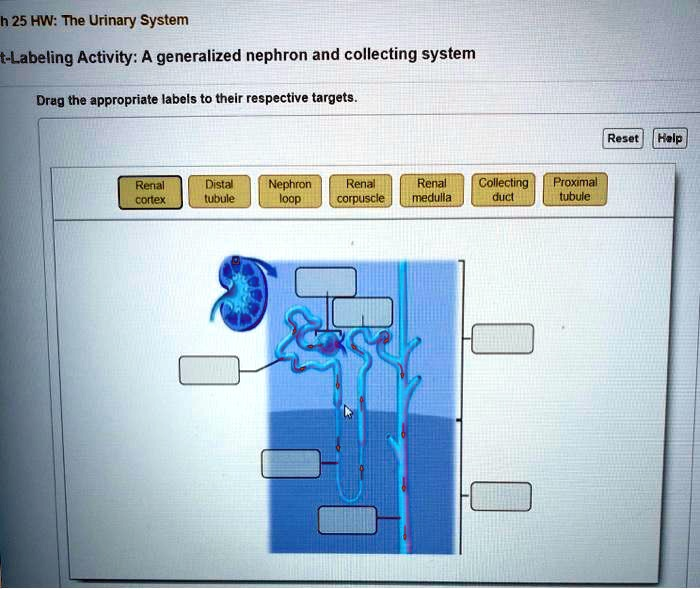
Here is the correct labeling for the diagram based on the parts of the nephron and collecting system:
Correct Labels (Top to Bottom, Left to Right):
- Renal corpuscle (Top center of the nephron, ball-like structure)
- Proximal tubule (First tubule leaving the renal corpuscle)
- Nephron loop (Descending and ascending loop going into the medulla)
- Distal tubule (Tubule returning from the loop and leading toward collecting duct)
- Collecting duct (Long straight duct moving down through the medulla)
- Renal cortex (Lighter top region of the kidney diagram)
- Renal medulla (Darker bottom region of the kidney diagram)
Explanation
The nephron is the functional unit of the kidney, responsible for filtering blood and forming urine. Each nephron consists of a renal corpuscle and a renal tubule, which further subdivides into different segments with specific roles.
The renal corpuscle, located in the renal cortex, initiates filtration. It includes the glomerulus (a tuft of capillaries) and Bowman’s capsule. Blood pressure forces water and solutes out of the capillaries into the capsule, beginning the process of urine formation.
Next, the filtrate enters the proximal tubule, also in the cortex, where most of the water, ions, and nutrients are reabsorbed back into the bloodstream. The tubule leads into the nephron loop (Loop of Henle), which dips into the renal medulla. The descending limb allows water to exit, while the ascending limb actively transports salts out, creating a concentration gradient essential for water reabsorption.
After the loop, the filtrate enters the distal tubule, again in the cortex. Here, selective reabsorption and secretion fine-tune the filtrate’s composition, especially in response to hormonal signals like aldosterone.
Finally, the filtrate moves into the collecting duct, which travels down through the renal medulla. The collecting duct plays a vital role in water reabsorption and concentration of urine, regulated by antidiuretic hormone (ADH). The final urine is transported toward the renal pelvis and eventually to the bladder.
Understanding these structures and their locations—renal cortex (outer layer) and renal medulla (inner region)—is crucial for grasping how the kidney concentrates urine and maintains body fluid balance.