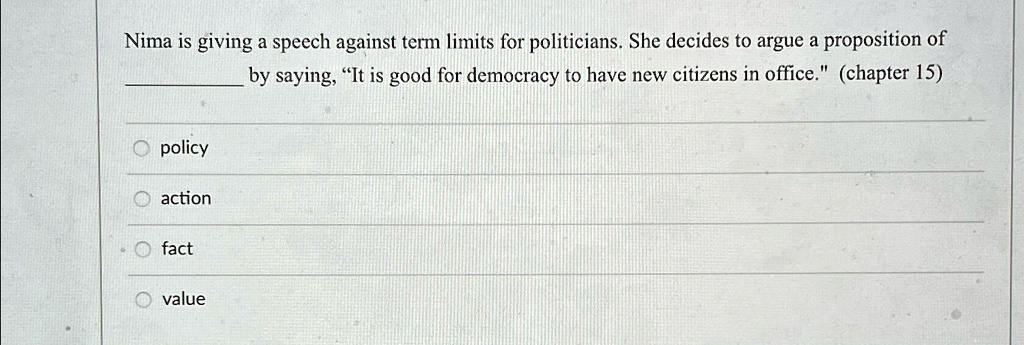
Nima is giving a speech against term limits for politicians. She decides to argue a proposition of by saying, “It is good for democracy to have new citizens in office.” (chapter 15) O policy action fact O value
The Correct Answer and Explanation is:
The correct answer is: value.
Explanation:
In persuasive speaking, a proposition of value argues whether something is good or bad, right or wrong, ethical or unethical, moral or immoral. These propositions do not focus on what is or what should be done, but rather on the worth or importance of something.
In the scenario, Nima is giving a speech against term limits for politicians. She supports her position by saying, “It is good for democracy to have new citizens in office.” This statement does not attempt to prove a fact (something verifiable), nor does it recommend a specific action (a call for doing something), nor is it advocating for a policy (a rule or law to be enacted or changed).
Instead, the phrase “It is good for democracy…” expresses a judgment about value—Nima is stating what she believes is beneficial or desirable for democracy. Her argument centers around the idea that having new citizens in office is a positive thing, which is a value-based perspective.
Let’s briefly contrast the types:
- Proposition of fact: Asserts whether something is true or false. (e.g., “The Earth orbits the sun.”)
- Proposition of policy: Advocates for a specific change or course of action. (e.g., “The city should implement term limits.”)
- Proposition of action: Often overlaps with policy, focused on urging specific behaviors or steps. (e.g., “We must vote to change this.”)
- Proposition of value: Evaluates the worth or morality of an idea. (e.g., “It is good for democracy to rotate leadership.”)
Because Nima is arguing that something is good, she is making a value judgment, not asserting a fact or urging action/policy. Therefore, the correct answer is value.
