Consider a rectangular loop of wire with width w, height h, and total resistance R. The region of space occupied by the wire loop contains a uniform magnetic field
pointing out of the screen. A motor attached to the loop keeps it rotating about the vertical axis with constant angular velocity
. At time
, the loop is parallel to the screen(as shown in the figure).
Use the following format (scientific notation) For example 0.00124 enter 1.24E-3 A) What is the maximum value (amplitude) of the magnetic flux
through the loop, in units T
m
? B) What is the maximum value (amplitude) of the induced EMF through the loop, in units V? C) What is the maximum value (amplitude) of the induced current
through the loop, in units A? D) What is the maximum value (amplitude) of the torque
provided by the motor to keep the loop rotating at a constant angular velocity, in units N
m?
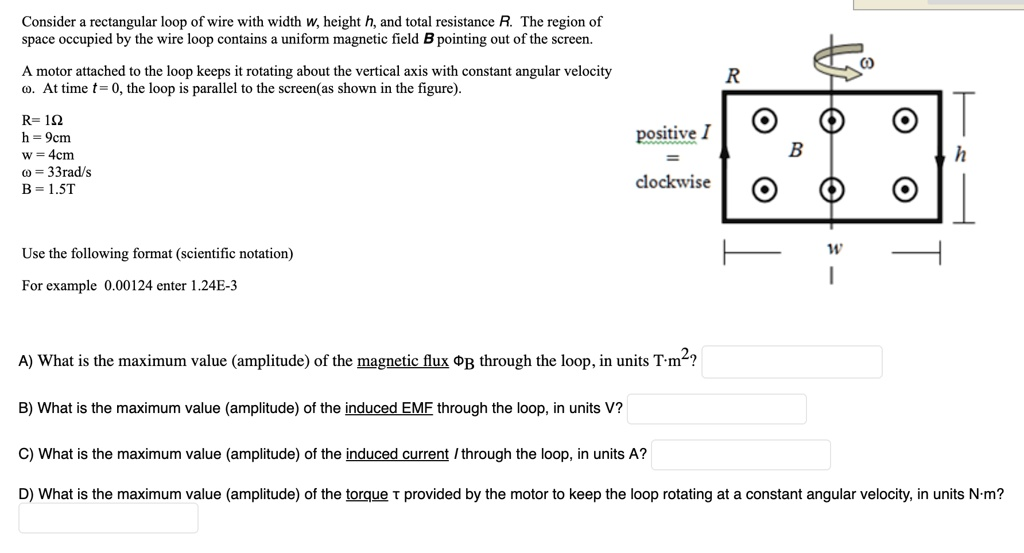
The Correct Answer and Explanation is:
Let’s solve each part step by step using the provided data:
Given:
- R=1 ΩR = 1 \, \Omega
- h=9 cm=0.09 mh = 9\, \text{cm} = 0.09\, \text{m}
- w=4 cm=0.04 mw = 4\, \text{cm} = 0.04\, \text{m}
- ω=33 rad/s\omega = 33\, \text{rad/s}
- B=1.5 TB = 1.5\, \text{T}
A) Maximum Magnetic Flux ΦB\Phi_B
Magnetic flux through the loop is given by: ΦB=B⋅A⋅cos(θ)\Phi_B = B \cdot A \cdot \cos(\theta)
The maximum value is when cos(θ)=1\cos(\theta) = 1, so: ΦBmax=B⋅A=B⋅w⋅h\Phi_{B_{\text{max}}} = B \cdot A = B \cdot w \cdot h =1.5⋅0.04⋅0.09=5.4×10⁻³ T\cdotpm2= 1.5 \cdot 0.04 \cdot 0.09 = 5.4 \times 10^{-3} \, \text{T·m}^2
Answer: 5.4E-3
B) Maximum Induced EMF
EMF is given by Faraday’s Law: E(t)=∣dΦBdt∣=B⋅A⋅ω⋅sin(ωt)\mathcal{E}(t) = \left| \frac{d\Phi_B}{dt} \right| = B \cdot A \cdot \omega \cdot \sin(\omega t)
The maximum EMF occurs when sin(ωt)=1\sin(\omega t) = 1: Emax=B⋅A⋅ω=1.5⋅0.04⋅0.09⋅33\mathcal{E}_{\text{max}} = B \cdot A \cdot \omega = 1.5 \cdot 0.04 \cdot 0.09 \cdot 33 =0.1782 V= 0.1782 \, \text{V}
Answer: 1.782E-1
C) Maximum Induced Current
Ohm’s Law: I=ERI = \frac{\mathcal{E}}{R} Imax=0.17821=0.1782 AI_{\text{max}} = \frac{0.1782}{1} = 0.1782 \, \text{A}
Answer: 1.782E-1
D) Maximum Torque
Maximum torque τ\tau is given by: τmax=N⋅B⋅A⋅Imax\tau_{\text{max}} = N \cdot B \cdot A \cdot I_{\text{max}}
(Here, N=1N = 1 turn) τmax=1⋅1.5⋅0.04⋅0.09⋅0.1782=9.622E−4 N\cdotpm\tau_{\text{max}} = 1 \cdot 1.5 \cdot 0.04 \cdot 0.09 \cdot 0.1782 = 9.622E-4 \, \text{N·m}
Answer: 9.622E-4
Summary:
| Part | Quantity | Answer |
|---|---|---|
| A | Magnetic Flux ΦB\Phi_B | 5.4E-3 T·m² |
| B | Induced EMF | 1.782E-1 V |
| C | Induced Current | 1.782E-1 A |
| D | Torque τ\tau | 9.622E-4 N·m |
Explanation
This problem applies electromagnetic induction to a rotating rectangular loop in a uniform magnetic field. As the loop rotates, the angle between the loop’s area vector and the magnetic field changes, producing a time-varying magnetic flux. According to Faraday’s Law, a changing flux through the loop induces an electromotive force (EMF), which in turn causes a current if the circuit is closed.
Part A focuses on magnetic flux, which is a measure of how much magnetic field passes through the loop. The maximum flux occurs when the plane of the loop is perpendicular to the magnetic field (maximum area exposed to the field), which is simply the product of the magnetic field and area of the loop.
Part B deals with the induced EMF, which is the rate of change of the magnetic flux. As the loop rotates, the flux varies sinusoidally. The maximum EMF corresponds to the maximum rate of change, which is proportional to the angular velocity ω\omega, magnetic field BB, and loop area.
Part C uses Ohm’s Law. Since the loop has a resistance RR, the EMF causes a current. The current’s maximum value corresponds to the peak EMF divided by resistance.
Part D involves torque. The current-carrying loop in a magnetic field experiences a torque that opposes rotation. To keep it spinning at a constant speed, the motor must apply an equal and opposite torque. The maximum torque occurs when the current and area vector are perpendicular to the magnetic field.
This setup is a classic model for how electric generators and motors work, showcasing the interplay between magnetism, motion, and electricity.