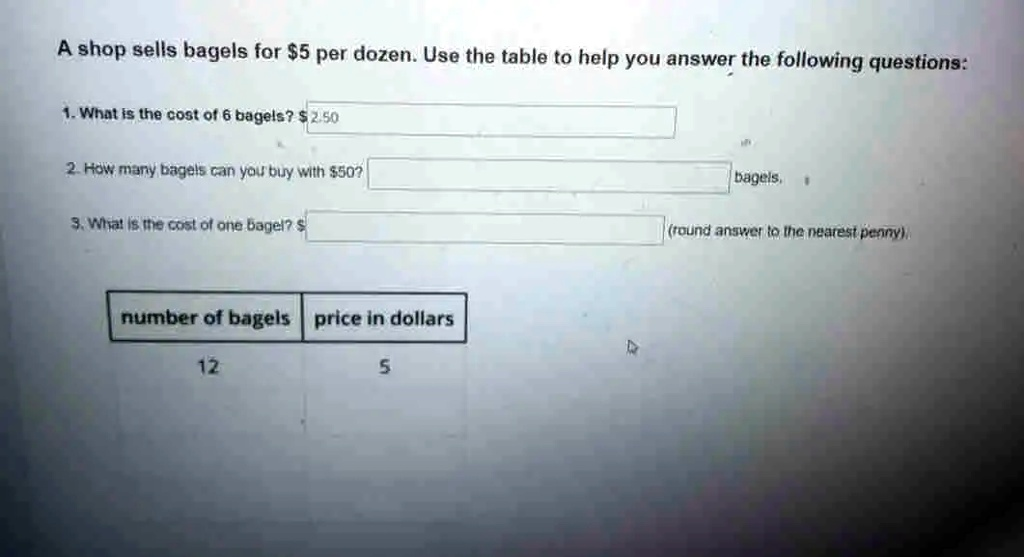
A shop sells bagels for
2.50 2. How many bagels can you buy with
(round answer to the nearest penny) number of bagels price in dollars 12 5
The Correct Answer and Explanation is:
Let’s work through the problem step by step using the information from the image.
Given:
- A shop sells 12 bagels for $5 (1 dozen = 12).
- This means each bagel costs: 512=0.4166…≈0.42 (rounded to the nearest penny)\frac{5}{12} = 0.4166\ldots \approx 0.42 \text{ (rounded to the nearest penny)}
1. What is the cost of 6 bagels?
Since one bagel costs approximately $0.42, the cost of 6 bagels is: 6×0.4166…=2.506 \times 0.4166\ldots = 2.50
Answer: $2.50 ✔️ (Already filled correctly)
2. How many bagels can you buy with $50?
We know:
- $5 gets you 12 bagels.
- So $50 gets you:
50÷5=10 (sets of 12 bagels)50 \div 5 = 10 \text{ (sets of 12 bagels)} 10×12=120 bagels10 \times 12 = 120 \text{ bagels}
Answer: 120 bagels ✔️
3. What is the cost of one bagel?
As calculated earlier: 512=0.41666…≈0.42\frac{5}{12} = 0.41666\ldots \approx 0.42
Answer: $0.42 ✔️
Explanation:
The problem involves unit pricing and basic arithmetic. You are told that a shop sells a dozen bagels (12 bagels) for $5. From this, you can derive the cost of one bagel by dividing the total price by the number of bagels: $5 ÷ 12 = approximately $0.4166. Rounded to the nearest penny, this gives us $0.42 per bagel.
Once we know the unit price, we can answer any related question. For instance, to find the cost of 6 bagels, you multiply the unit price ($0.4166…) by 6, which gives about $2.50. That’s half a dozen bagels for half the price of a dozen—this checks out logically.
For the second question, you’re asked how many bagels you can buy with $50. If 12 bagels cost $5, then you divide $50 by $5 to find how many sets of 12 bagels you can afford. $50 ÷ $5 = 10. Since each set includes 12 bagels, you multiply 10 × 12 to get 120 bagels.
Understanding unit pricing is a key math skill used in shopping, budgeting, and business. It helps consumers compare prices and make informed decisions. In this example, by breaking down the problem into smaller steps—finding the cost per item, multiplying or dividing as needed—you arrive at correct, logical answers.