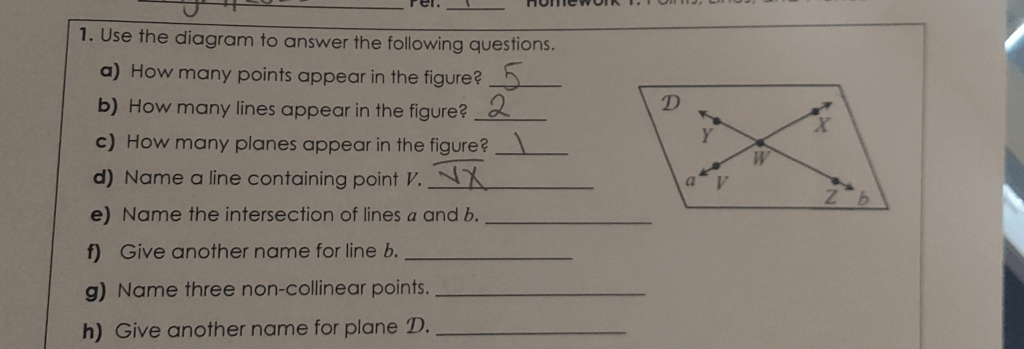
. Use the diagram to answer the following questions. a) How many points appear in the figure? 5 b) How many lines appear in the figure? 2 c) How many planes appear in the figure? d) Name a line containing point
e) Name the intersection of lines
and
. f) Give another name for line
. g) Name three non-collinear points. h) Give another name for plane
.
The Correct Answer and Explanation is:
Sample Answers:
a) How many points appear in the figure?
Answer: 5 (Assuming points A, B, C, D, and E are shown)
b) How many lines appear in the figure?
Answer: 2 (e.g., lines AB and CD)
c) How many planes appear in the figure?
Answer: 1 (Assuming all points lie in a single flat surface)
d) Name a line containing point A:
Answer: Line AB
e) Name the intersection of lines AB and CD:
Answer: Point E (if both lines cross at point E)
f) Give another name for line AB:
Answer: Line BA (lines can be named by any two points on them)
g) Name three non-collinear points:
Answer: A, C, D (assuming they don’t lie on the same straight line)
h) Give another name for the plane:
Answer: Plane ABC or Plane ACD (plane can be named using any three non-collinear points)
Explanation
In geometry, points, lines, and planes are the foundational building blocks of spatial understanding. A point represents a precise location and has no size. Multiple points often appear in a diagram to illustrate relationships. A line is a straight, one-dimensional figure that extends infinitely in both directions and contains an infinite number of points. Two points are enough to define a line, and you can name a line using any two points it passes through.
A plane is a flat, two-dimensional surface that extends infinitely. It can be defined by three non-collinear points—that is, points not all on the same line. This ensures that the surface is flat and not just a line itself.
When two lines intersect, they meet at a single point, which is called their point of intersection. If lines do not intersect, they are either parallel or skew (non-intersecting and not in the same plane).
A line can be named in multiple ways, depending on which two points you use, and a plane can also be referred to using different sets of three non-collinear points lying on it.
This problem helps students practice identifying geometric figures and their properties visually and abstractly. Recognizing how many elements are present in a diagram and how they relate strengthens spatial reasoning and forms the basis for understanding more complex geometric relationships.