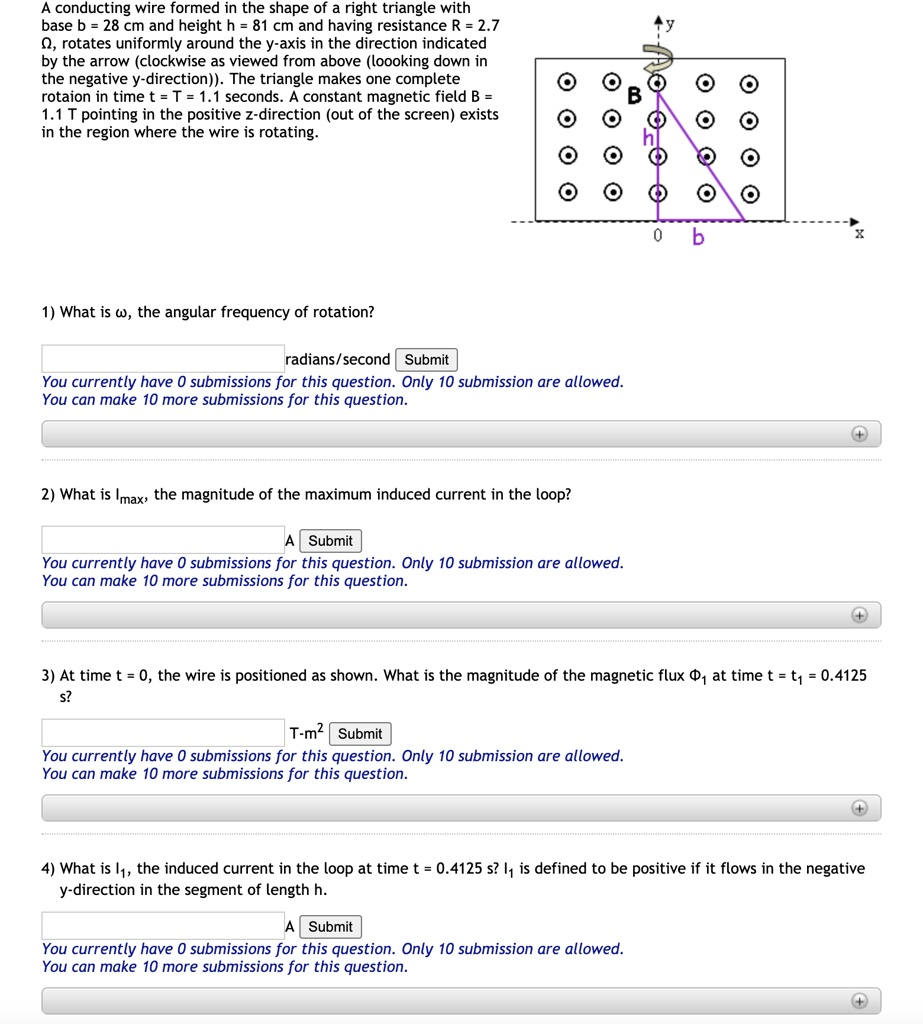
Conducting wire formed in the shape of a right triangle with base b = 28 cm and height h = 81 cm and having resistance R = 2.7 rotates uniformly around the Y-axis in the direction indicated by the arrow (clockwise as viewed from above, looking down in the negative Y-direction). The triangle makes one complete rotation in time seconds. A constant magnetic field B = 1.1 T pointing in the positive z-direction (out of the screen) exists in the region where the wire is rotating. 1) What is W, the angular frequency of rotation? radians / second Submit You currently have 0 submissions for this question. Only 10 submissions are allowed: You can make 10 more submissions for this question. 2) What is Imax, the magnitude of the maximum induced current in the loop? Submit You currently have 0 submissions for this question. Only 10 submissions are allowed: You can make 10 more submissions for this question. 3) At time t = 0, the wire is positioned as shown. What is the magnitude of the magnetic flux Φ at time 0.4125 T-m^2? Submit You currently have 0 submissions for this question. Only 10 submissions are allowed: You can make 10 more submissions for this question. 4) What is I1, the induced current in the loop at time 0.4125 s? I is defined to be positive if it flows in the negative y-direction in the segment of length h. Submit You currently have 0 submissions for this question. Only 10 submissions are allowed: You can make 10 more submissions for this question.
Conducting wire formed in the shape of a right triangle with base b = 28 cm and height h = 81 cm and having resistance R = 2.7 rotates uniformly around the Y-axis in the direction indicated by the arrow (clockwise as viewed from above, looking down in the negative Y-direction). The triangle makes one complete rotation in time seconds. A constant magnetic field B = 1.1 T pointing in the positive z-direction (out of the screen) exists in the region where the wire is rotating. 1) What is W, the angular frequency of rotation? radians / second Submit You currently have 0 submissions for this question. Only 10 submissions are allowed: You can make 10 more submissions for this question. 2) What is Imax, the magnitude of the maximum induced current in the loop? Submit You currently have 0 submissions for this question. Only 10 submissions are allowed: You can make 10 more submissions for this question. 3) At time t = 0, the wire is positioned as shown. What is the magnitude of the magnetic flux Φ at time 0.4125 T-m^2? Submit You currently have 0 submissions for this question. Only 10 submissions are allowed: You can make 10 more submissions for this question. 4) What is I1, the induced current in the loop at time 0.4125 s? I is defined to be positive if it flows in the negative y-direction in the segment of length h. Submit You currently have 0 submissions for this question. Only 10 submissions are allowed: You can make 10 more submissions for this question.
The Correct Answer and Explanation is:
Given:
- Triangle: Right triangle with base b=0.28 mb = 0.28 \, \text{m}b=0.28m, height h=0.81 mh = 0.81 \, \text{m}h=0.81m
- Resistance: R=2.7 ΩR = 2.7 \, \OmegaR=2.7Ω
- Rotates about the y-axis, uniformly.
- Time for one rotation: T=1.1 sT = 1.1 \, \text{s}T=1.1s
- Magnetic field: B=1.1 TB = 1.1 \, \text{T}B=1.1T (constant, out of the screen, +z^+\hat{z}+z^ direction)
1) What is ω\omegaω, the angular frequency of rotation?
Angular frequency: ω=2πT=2π1.1≈5.712 rad/s\omega = \frac{2\pi}{T} = \frac{2\pi}{1.1} \approx 5.712 \, \text{rad/s}ω=T2π=1.12π≈5.712rad/s
2) What is ImaxI_{\text{max}}Imax, the maximum induced current?
Max EMF is: Emax=B⋅A⋅ω\mathcal{E}_{\text{max}} = B \cdot A \cdot \omegaEmax=B⋅A⋅ω
Area AAA of triangle: A=12bh=12(0.28)(0.81)=0.1134 m2A = \frac{1}{2} b h = \frac{1}{2} (0.28)(0.81) = 0.1134 \, \text{m}^2A=21bh=21(0.28)(0.81)=0.1134m2 Emax=1.1⋅0.1134⋅5.712≈0.712 V\mathcal{E}_{\text{max}} = 1.1 \cdot 0.1134 \cdot 5.712 \approx 0.712 \, \text{V}Emax=1.1⋅0.1134⋅5.712≈0.712V Imax=EmaxR=0.7122.7≈0.264 AI_{\text{max}} = \frac{\mathcal{E}_{\text{max}}}{R} = \frac{0.712}{2.7} \approx 0.264 \, \text{A}Imax=REmax=2.70.712≈0.264A
3) What is the magnetic flux Φ1\Phi_1Φ1 at t=0.4125 st = 0.4125 \, \text{s}t=0.4125s?
Flux: Φ(t)=BAcos(ωt)\Phi(t) = B A \cos(\omega t)Φ(t)=BAcos(ωt)
Using previously calculated values:
- ωt=5.712⋅0.4125≈2.356 rad\omega t = 5.712 \cdot 0.4125 \approx 2.356 \, \text{rad}ωt=5.712⋅0.4125≈2.356rad
Φ=1.1⋅0.1134⋅cos(2.356)≈0.1247⋅(−0.707)≈−0.0882 Wb (or T\cdotpm2)\Phi = 1.1 \cdot 0.1134 \cdot \cos(2.356) \approx 0.1247 \cdot (-0.707) \approx -0.0882 \, \text{Wb (or T·m}^2)Φ=1.1⋅0.1134⋅cos(2.356)≈0.1247⋅(−0.707)≈−0.0882Wb (or T\cdotpm2)
Magnitude: ∣Φ∣=0.0882 T\cdotpm2|\Phi| = 0.0882 \, \text{T·m}^2∣Φ∣=0.0882T\cdotpm2
4) What is I1I_1I1 at t=0.4125 st = 0.4125 \, \text{s}t=0.4125s?
Induced EMF: E=−dΦdt=BAωsin(ωt)\mathcal{E} = – \frac{d\Phi}{dt} = B A \omega \sin(\omega t)E=−dtdΦ=BAωsin(ωt) E=1.1⋅0.1134⋅5.712⋅sin(2.356)≈0.712⋅0.707≈0.503 V\mathcal{E} = 1.1 \cdot 0.1134 \cdot 5.712 \cdot \sin(2.356) \approx 0.712 \cdot 0.707 \approx 0.503 \, \text{V}E=1.1⋅0.1134⋅5.712⋅sin(2.356)≈0.712⋅0.707≈0.503V I1=ER=0.5032.7≈0.186 AI_1 = \frac{\mathcal{E}}{R} = \frac{0.503}{2.7} \approx 0.186 \, \text{A}I1=RE=2.70.503≈0.186A
Summary of Correct Answers:
- ω=5.712 rad/s\omega = 5.712 \, \text{rad/s}ω=5.712rad/s
- Imax=0.264 AI_{\text{max}} = 0.264 \, \text{A}Imax=0.264A
- Φ1=0.0882 T\cdotpm2\Phi_1 = 0.0882 \, \text{T·m}^2Φ1=0.0882T\cdotpm2
- I1=0.186 AI_1 = 0.186 \, \text{A}I1=0.186A
Explanation
This problem illustrates electromagnetic induction due to a rotating wire loop in a magnetic field. The conducting wire is shaped into a right triangle and rotates uniformly about the y-axis. As it rotates, the area vector of the loop changes its orientation relative to the magnetic field, leading to a time-varying magnetic flux. According to Faraday’s Law of Induction, a time-varying magnetic flux through a loop induces an electromotive force (EMF), which can drive a current if the loop has resistance.
The angular frequency ω\omegaω is directly related to the period TTT of rotation. With T=1.1 sT = 1.1 \, \text{s}T=1.1s, we calculate ω=2π/T\omega = 2\pi / Tω=2π/T. The maximum EMF is when the rate of change of flux is at its peak, corresponding to the sine function reaching its maximum value. We multiply the angular frequency ω\omegaω, magnetic field strength BBB, and the area of the loop to get the peak EMF. Dividing by the resistance gives us the maximum current, ImaxI_{\text{max}}Imax.
At a specific time t=0.4125 st = 0.4125 \, \text{s}t=0.4125s, the flux through the loop is found by evaluating Φ=BAcos(ωt)\Phi = BA \cos(\omega t)Φ=BAcos(ωt). The instantaneous induced current is then computed using I=(BAωsin(ωt))/RI = (B A \omega \sin(\omega t)) / RI=(BAωsin(ωt))/R. The sinusoidal nature of flux and current is a hallmark of rotating systems in uniform magnetic fields.
This system models real-world applications like electric generators, where mechanical rotation converts into electric current using magnetic induction.