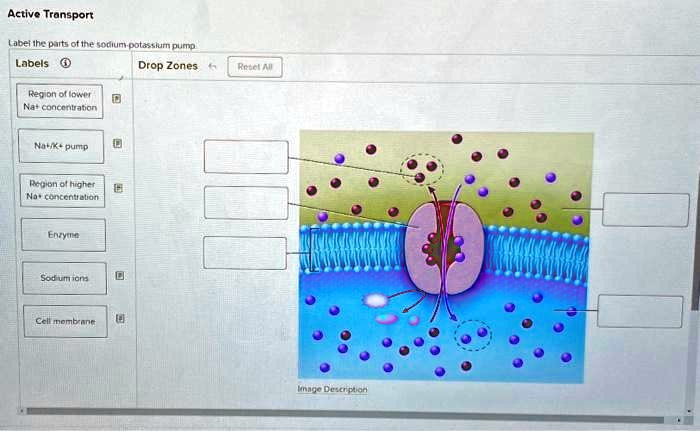
Active Transport Label the parts of the sodium-potassium pump Labels Region of lower Na+ concentration Na+/K+ pump Region of higher Na+ concentration Enzyme Sodium ions Cell membrane Drop Zones Reset All Image Description
The Correct Answer and Explanation is:
Correct Label Placement:
From top to bottom and left to right, the correct labels for the sodium-potassium pump diagram are:
- Region of higher Na⁺ concentration (upper left, outside the cell)
- Sodium ions (middle left, indicating purple Na⁺ ions)
- Region of lower Na⁺ concentration (lower left, inside the cell)
- Na⁺/K⁺ pump (center, the protein embedded in the membrane)
- Cell membrane (right middle, the bilayer structure)
- Enzyme (bottom right, referring to the ATPase activity of the pump)
Explanation
The sodium-potassium (Na⁺/K⁺) pump is a vital membrane protein responsible for maintaining the electrochemical gradient across the plasma membrane of animal cells. This process is an example of active transport, which requires energy in the form of ATP to move ions against their concentration gradients.
In this mechanism, three sodium ions (Na⁺) from the intracellular (cytoplasmic) region, where sodium concentration is low, bind to the pump. With the hydrolysis of ATP, the pump undergoes a conformational change and releases these sodium ions to the extracellular space, where the sodium concentration is high. This process moves sodium against its concentration gradient, which requires energy.
Simultaneously, two potassium ions (K⁺) from the extracellular region, where potassium concentration is high, bind to the pump. The protein then changes back to its original shape and transports the potassium ions into the intracellular space, where potassium concentration is low. This is also against potassium’s gradient.
The Na⁺/K⁺ pump is also referred to as Na⁺/K⁺-ATPase, indicating its enzyme activity, as it catalyzes the hydrolysis of ATP to ADP and phosphate to power the ion transport.
The pump is embedded in the cell membrane, a phospholipid bilayer that separates the cell’s interior from the outside environment. The concentration gradients maintained by the pump are critical for various cellular functions, including nerve impulse conduction, muscle contraction, and maintaining osmotic balance.
In summary, the Na⁺/K⁺ pump exemplifies how cells use enzymes and energy to actively maintain homeostasis by controlling ion distributions across membranes.