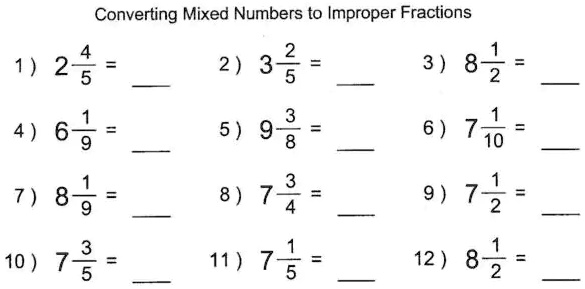
Converting Mixed Numbers to Improper Fractions 4 1) 2\frac{4}{5} = 2 2) 3\frac{2}{5} = 3) 8\frac{1}{2} = 1 4) 6\frac{1}{9} = 5) 9\frac{3}{8} = 6) 7\frac{1}{10} = 1 7) 8\frac{1}{9} = 8) 7\frac{3}{4} = 9) 7\frac{1}{2} = 3 1 10) 7\frac{3}{5} = 11) 7\frac{1}{5} = 12) 8\frac{1}{2}
The Correct Answer and Explanation is:
Correct Answers
245=145254=514325=175352=517812=172821=217619=559691=955938=758983=8757110=71107101=1071819=739891=973734=314743=431712=152721=215735=385753=538715=365751=536812=172821=217
Explanation
A mixed number is a value that combines a whole number and a proper fraction. An improper fraction is a fraction where the numerator (the top number) is greater than or equal to the denominator (the bottom number). Converting a mixed number to an improper fraction is a foundational skill in mathematics, essential for performing operations like multiplication and division with fractions. The process re-expresses the entire value as a single fraction.
The conversion follows a reliable three-step method.
Step 1: Multiply the whole number by the denominator.
This step calculates how many fractional parts are contained within the whole number portion of the mixed number. For example, in the mixed number
245254, the whole number is 2. Since the denominator is 5, each whole unit is equivalent to five-fifths (
5555). Therefore, two whole units contain
2×5=102×5=10fifths.
Step 2: Add the result to the original numerator.
This step combines the fractional parts from the whole number with the parts from the proper fraction. Continuing with the example
245254, the 10 fifths from the whole number are added to the existing 4 fifths from the fraction:
10+4=1410+4=14. This gives the total number of fractional parts.
Step 3: Place the new sum over the original denominator.
The final result is an improper fraction. The denominator does not change because it defines the size of the fractional parts (e.g., fifths, halves, ninths). For our example, the sum from Step 2, which is 14, becomes the new numerator, and it is placed over the original denominator of 5.
Thus, the mixed number
245254is correctly converted to the improper fraction
145514. This procedure works for any mixed number.thumb_upthumb_down
