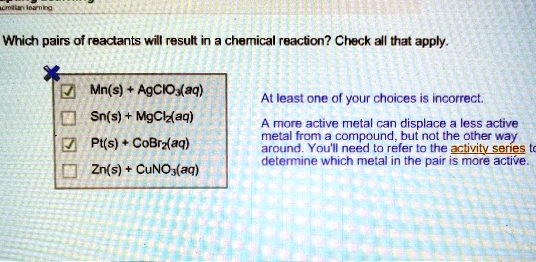
Which pairs of reactants will result in a chemical reaction? Check all that apply. * \checkmark Mn(s) + AgClO
(aq) Sn(s) + MgCl
(aq) \checkmark Pt(s) + CoBr
(aq) Zn(s) + CuNO
(aq) At least one of your choices is incorrect. A more active metal can displace a less active metal from a compound, but not the other way around. You’ll need to refer to the activity series to determine which metal in the pair is more active.
The Correct Answer and Explanation is:
. Mn(s) + AgClO₄(aq) ✅
Manganese (Mn) is above Silver (Ag) in the activity series.
→ Mn is more reactive and will displace Ag⁺ from AgClO₄.
✅ Reaction occurs.
2. Sn(s) + MgCl₂(aq) ❌
Tin (Sn) is below Magnesium (Mg) in the activity series.
→ Sn is less reactive and cannot displace Mg²⁺ from MgCl₂.
❌ No reaction.
3. Pt(s) + CoBr₂(aq) ❌
Platinum (Pt) is below Cobalt (Co) in the activity series.
→ Pt is less reactive and cannot displace Co²⁺ from CoBr₂.
❌ No reaction.
4. Zn(s) + CuNO₃(aq) ✅
Zinc (Zn) is above Copper (Cu) in the activity series.
→ Zn is more reactive and will displace Cu²⁺ from CuNO₃.
✅ Reaction occurs.
✅ Correct Answers:
- ✅ Mn(s) + AgClO₄(aq)
- ✅ Zn(s) + CuNO₃(aq)
📘 Explanation:
In single replacement reactions, the activity series of metals is used to predict whether a reaction will occur. Only a metal that is more reactive (higher on the activity series) than the metal ion in the compound can replace it. If it’s less reactive, no displacement occurs, and thus, no reaction. Always consult the activity series before predicting the outcome of such reactions.
