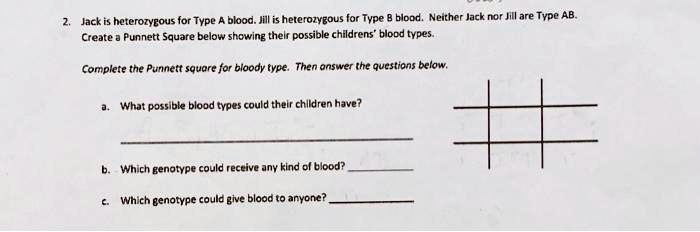
Jack is heterozygous for Type A blood. Jill is heterozygous for Type B blood. Neither Jack nor Jill are Type AB. Create a Punnett Square below showing their possible childrens’ blood types. Complete the Punnett square for bloody type. Then answer the questions below. a. What possible blood types could their children have? b. Which genotype could receive any kind of blood? c. Which genotype could give blood to anyone?
The Correct Answer and Explanation is:
Punnett Square and Answers:
Given:
- Jack = Heterozygous Type A = Genotype AO
- Jill = Heterozygous Type B = Genotype BO
Punnett Square:
| B | O | |
|---|---|---|
| A | AB | AO |
| O | BO | OO |
Answers:
a. What possible blood types could their children have?
A, B, AB, and O
b. Which genotype could receive any kind of blood?
AB
c. Which genotype could give blood to anyone?
O
Explanation
Human blood types are determined by the ABO gene, which comes in three alleles: A, B, and O. Every person inherits one allele from each parent, leading to four main blood types: A, B, AB, and O. Blood type A can be AA or AO, type B can be BB or BO, type AB is AB, and type O is OO.
In this scenario, Jack is heterozygous for type A, meaning his genotype is AO. Jill is heterozygous for type B, meaning her genotype is BO. To determine the possible blood types of their children, we use a Punnett square—a diagram that predicts the genotypes of offspring based on the alleles of the parents.
By placing Jack’s alleles (A and O) on one side of the square and Jill’s alleles (B and O) on the other, we calculate all combinations: AB, AO, BO, and OO. Each box in the Punnett square represents a 25% chance of that genotype. This results in four possible blood types:
- AB (from A and B)
- A (from A and O)
- B (from B and O)
- O (from O and O)
Thus, their children could have any of the four blood types, each with an equal probability.
The AB genotype can receive blood from any type (universal recipient) because it has both A and B antigens and no antibodies against A or B. The O genotype is the universal donor because it has no A or B antigens on the red cells, so it won’t trigger an immune response in recipients of any blood type.
Understanding inheritance patterns like these helps explain genetic probability and is vital in medicine, especially in transfusions and organ transplants.