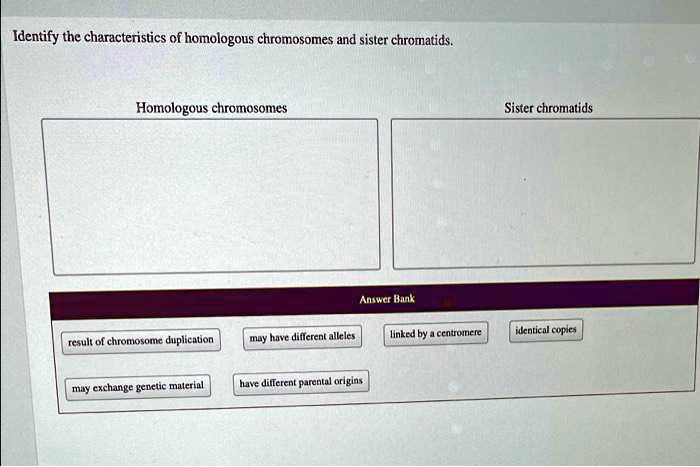
Identify the characteristics of homologous chromosomes and sister chromatids. Homologous chromosomes: [Empty Box] Sister chromatids: [Empty Box] Answer Bank: result of chromosome duplication, may have different alleles, linked by a centromere, identical copies, may exchange genetic material, have different parental origins
The Correct Answer and Explanation is:
Homologous chromosomes:
- may have different alleles
- may exchange genetic material
- have different parental origins
Sister chromatids:
- result of chromosome duplication
- linked by a centromere
- identical copies
Explanation
In genetics and cell biology, it is essential to distinguish between homologous chromosomes and sister chromatids, as they play different roles in inheritance and cell division.
Homologous Chromosomes
Homologous chromosomes are pairs of chromosomes found in diploid organisms, such as humans. Each pair consists of one chromosome inherited from the maternal parent and one from the paternal parent.
- Have different parental origins: This is their defining feature. For each of the 23 pairs of chromosomes in a human cell, one is from the mother and its homolog is from the father.
- May have different alleles: Homologous chromosomes are the same length, have their centromeres in the same position, and carry genes for the same traits (e.g., eye color, blood type) at corresponding locations called loci. However, the specific versions of these genes, known as alleles, may differ between the two chromosomes. For example, one chromosome may carry the allele for type A blood, while its homolog carries the allele for type O blood.
- May exchange genetic material: During prophase I of meiosis, homologous chromosomes pair up in a process called synapsis. While paired, they can undergo crossing over, where they swap segments of DNA. This process creates new combinations of alleles on the chromosomes, which is a major source of genetic variation in sexually reproducing organisms.
Sister Chromatids
Sister chromatids are the two identical copies of a single chromosome that are produced during DNA replication.
- Result of chromosome duplication: Before a cell divides (either by mitosis or meiosis), it must first copy its entire genome. This occurs during the S (synthesis) phase of the cell cycle. The result is that each chromosome consists of two identical sister chromatids.
- Identical copies: Because they are the direct products of DNA replication, sister chromatids are genetically identical. They contain the exact same genes and the same alleles, barring any rare mutation that might occur during the replication process.
- Linked by a centromere: The two sister chromatids are held together by a specialized DNA region called the centromere. They remain attached as a single replicated chromosome until they are separated during anaphase of mitosis or anaphase II of meiosis. This connection ensures that each new daughter cell receives one complete copy of the chromosome.